

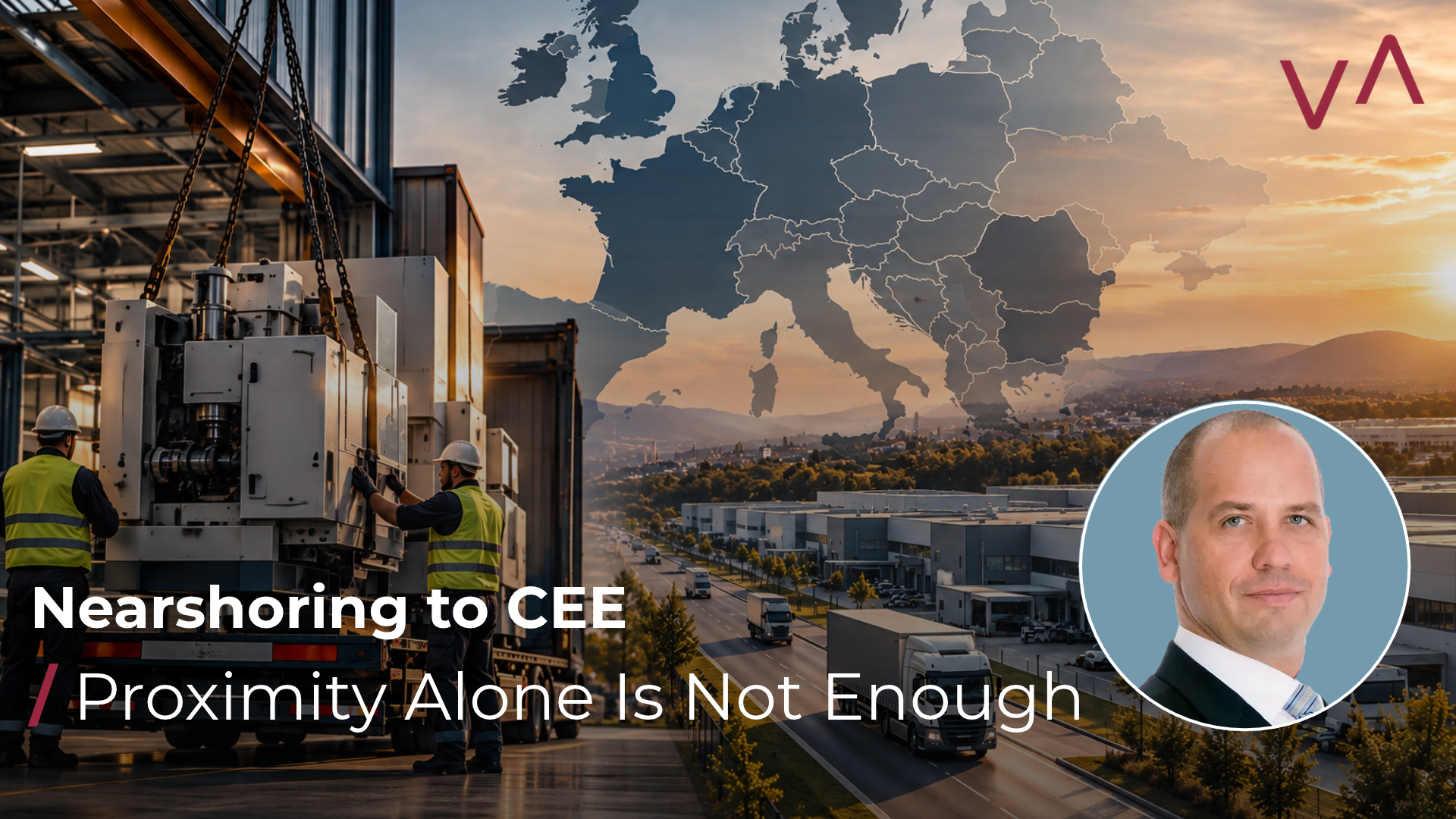
Nearshoring is reshaping European manufacturing. After decades of offshoring production to distant regions, manufacturers are bringing operations closer to home. Nearshoring to Central and Eastern Europe has quickly become a top strategic move for building resilient, agile supply chains. However, relocating always comes with operational risks: Transferring heavy machinery, relocating complex tooling, and ramping up factory floors under tight customer deadlines is never easy.
Bohuslav Lipovsky, CEO of CE Interim Management Group and Regional Partner of the Valtus Alliance for Central and Eastern Europe, the Balkans, and the Baltic states explains how a relocation can be done successfully – without costly downtime. In this article, he also shares practical insights on a case study and a 90-day interim management intervention.
Why Nearshoring?
Years of shocks exposed how fragile global supply chains had become. There were pandemic shutdowns and there are still severe shipping delays and trade disruptions. So companies began asking tough questions: What is the real cost of producing far away? Those questions led to action. In 2024 alone, foreign direct investment in manufacturing across CEE jumped 28%, with Hungary and Poland seeing record inflows. This is not a trend. It is a strategic pivot.
Why Nearshoring to CEE?
CEE countries like Poland, Hungary, Czechia, and Romania offer a value proposition that few other regions can match. They provide the right balance of cost, talent, and location. A factory in Slovakia can reach Munich in under ten hours by truck. Products assembled in Romania can be in Italy or France within days, not weeks.
With modern infrastructure and EU membership, cross-border trade is smoother and regulations more consistent. Nearshoring simplifies adherence to strict EU sustainability standards, lowers carbon emissions across the value chain, and ensures full compliance with European quality and labor laws.
There are also financial benefits: Corporate tax rates in Hungary sit at just 9%, among the lowest in Europe. Many CEE nations offer grants, tax holidays, and special economic zones for manufacturers ready to invest and create jobs. The region combines skilled labour at competitive cost: Wages remain up to 60% lower than in Western Europe.
Beyond those advantages, CEE nearshoring also increases supply chain agility: Shorter transport distances cut lead times dramatically. This lets companies adapt quickly to shifting market demand while locking up far less working capital in safety stock and sea freight.
The nearshoring trend to Eastern Europe is also fuelled by a rather recent trend: A growing number of automotive executives are turning to defence production. Rising NATO defence spending and EU defence funding programs create a compelling opportunity for automotive companies to adapt. Notably Poland, Hungary, and Romania have emerged as a prime destinations for defence production.
The nearshoring trend to CEE is already visible. BMW’s Debrecen plant in Hungary illustrates this momentum. Intel has committed billions to a semiconductor facility in Poland. Stellantis and Volkswagen are expanding in Poland and Slovakia, turning CEE into an electric vehicle hub. KNDS, a European defence industry holding company, chose Poland for its plant relocation strategy.
Relocations fail on execution, not strategy.
After taking the decision to relocate to CEE, this is where companies often get stuck: Who is going to run the project? Who will do the local hiring? Poland, for example, entered 2026 with investment commitments advancing faster than the labour base around them. Who will align quality standards and secure production deadlines? Transferring operational capacity is rarely a simple exercise.
The nearshoring plan almost never captures the importance of operational knowledge: The team that knew how to run the line is at the old site. They knew the informal adjustments that kept quality consistent, but most of that is not formal knowledge, written down in manuals. Equipment behaves differently in the new facility: humidity levels, power supply variance, floor vibration, and temperature ranges all require recalibration that nobody budgeted time or expertise for. Workforce rhythm takes longer to establish than anyone planned, with new hires and agency workers operating under production pressure from day one.
This can result in quality problems that quietly build for weeks before anyone notices it, with customer confidence eroding in parallel. In demanding sectors like automotive manufacturing and defense contracting, unexpected downtime can result in severe contractual penalties and damaged customer trust.
Four Reasons why Factory Relocations Fail in Practice
Based on hands-on restructuring experience across CEE, plant relocations fail because of four root causes:
- Ignoring Regional Nuances: Attempting a direct copy-and-paste of home-country operating models fails to account for regional labor market dynamics and local regulatory timelines.
- Lack of Dedicated Leadership: Assigning a complex relocation project to an existing plant manager as an extra task leads to operational overload and missed milestones.
- Communication Gaps: Misalignment between corporate headquarters and local execution teams creates friction and delays critical technical decisions.
- Overly Aggressive Ramp-Up Curves: Pushing lines to max capacity before processes, tooling, and local supply chains are fully stabilized leads to high scrap rates and emergency stops.
To secure a smooth transition, key operational challenges include:
- Tooling Integrity: Relocating specialized molds, dies, and automated assembly lines requires precision disassembly, transport, and re-qualification.
- Parallel Production: To prevent supply disruptions for major OEMs, companies must carefully coordinate buffer stocks or run parallel operations during the transition window.
- Regulatory Audits: Re-qualifying plants and equipment under ISO, IATF, or defense-specific compliance standards demands immaculate process documentation and immediate operational readiness.
- Training: To begin with, the workers at the new plant should be trained at the old plant. Ideally, they should work alongside the team on a shift basis for one or two weeks. Once production has started at the new plant, workers from the old plant should continue to work there on the new site. Not just for a few days, but for at least a few weeks.
Relocation and Program Recovery in Practice: A case study
In one case, a privately owned European SME in the Engineering, Procurement and Construction sector faced a critical inflection point: a new greenfield production facility in Poland, funded by EU grants, with founders who lacked the executive capacity to manage the transition. An interim CEO was deployed with full P&L authority and significant on-site presence. Within 90 days, production ramp-up was stabilised with quality controls in place. Escalation volume was reduced by over 50% in the first six months. The new facility reached operational break-even within twelve months.
This is what the structured 90-day interim management intervention included:
Days 1–15: Direct Operational Audit & Bottleneck Identification
An interim leader embeds directly on the shop floor to evaluate machine availability, supply chain bottlenecks, scrap root causes, and management gaps. Immediate firefighting protocols are established.
Days 16–45: Process Control & Resource Realignment
Core operational milestones are reset. Bottlenecks in tooling setup, material supply, or workforce training are resolved through direct leadership. Shifts operate under clear, daily KPI tracking.
Days 46–90: Stabilization & Ramp-Up Acceleration
Target cycle times and quality metrics are locked in. Local leadership structures are reinforced, standard operating procedures are finalized, and a fully operational plant is handed back to permanent management.
Three structural elements turned the distressed ramp-up around:
- a weekly steering cadence with fixed accountability
- a single point of accountability on site
- a clear role definition across functions.
Relocation often sits in no-man’s-land: Facilities think it is a production issue, production thinks logistics owns it, logistics assumes facility has it covered. A clear ownership structure prevents the single most common execution failure: nobody knowing who is really doing what.
The Leadership Gap That Amplifies Everything
A successful ramp-up does not need a project manager or a consultant producing a plan. It needs a senior operational leader who has run a post-transfer stabilisation period before, who has the authority to make decisions on the floor without escalating everything to group level, and who can hold two conversations simultaneously: one with a stressed workforce that needs direction, and one with a board that needs clarity.
Why Interim Leadership Makes the Difference
Relocations and nearshoring require specialized expertise that internal management teams rarely possess in-house. Dedicated Interim Executives fill this vital capability gap. By combining strategic perspective with hands-on shop-floor authority, experienced interim leaders take direct accountability for transition targets. It is their task to ensure that complex nearshoring investments deliver their promised resilience fast and in the long-term financial returns.
Nearshoring is a present-day opportunity, not a future trend. Poland, Czech Republic, Slovakia, Serbia, Bulgaria, Hungary or Romania are open for business, and the early movers are already securing prime sites, top talent, and local incentives. But choosing the right location is only the beginning. The companies that succeed will be those that pair the geographic decision with the governance, operational readiness, and experienced interim leadership to make it work. Because a strategy is only as strong as its execution.
About the author
Bohuslav Lipovsky is CEO of CE Interim Management Group and Regional Partner of the Valtus Alliance for Central and Eastern Europe, the Balkans, and the Baltic states. He leads restructuring, crisis recovery, and cross-border stabilisation programs, with extensive experience in industrial turnaround, CEO transitions, and multi-country execution.