

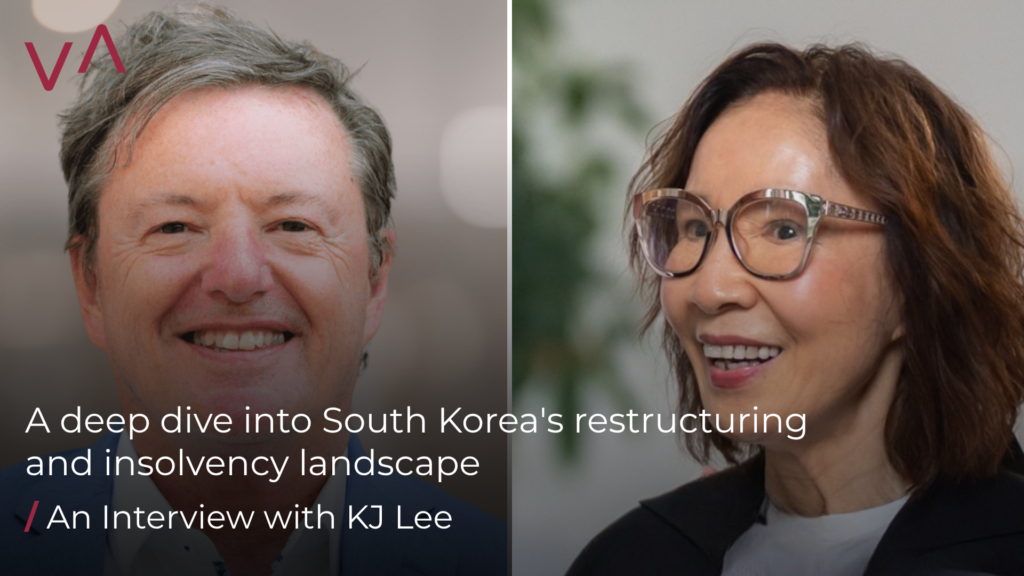
In an environment of global economic shifts and domestic pressures, South Korea’s framework for corporate restructuring and insolvency is more relevant than ever. At Valtus, we rely on an international network of restructuring experts, recognizing that each country has its own legal framework and restructuring practice. In this interview, KJ Lee, Partner at You & Partner in South Korea, explains to Wim de Mulder, Partner at VALPEO in the Netherlands, how restructuring is approached in South Korea.
What makes the legal framework for insolvency and restructuring unique in South Korea?
South Korea’s approach to corporate restructuring is fundamentally a dual-track system, offering both court-supervised and out-of-court solutions. This provides a degree of flexibility that is a hallmark of our framework.
The primary formal route is the Court-Supervised Rehabilitation process, governed by the Debtor Rehabilitation and Bankruptcy Act (DRBA). This is often compared to Chapter 11 in the United States, designed for companies that are financially distressed but fundamentally viable. The process begins with a filing, after which the court typically appoints a receiver – often from the existing management, a practice known as debtor-in-possession – and issues a stay order to freeze creditor claims. This protective environment allows the company to draft a rehabilitation plan, which can include a range of measures from debt restructuring and asset sales to operational layoffs. The plan requires both creditor approval and court confirmation to be executed. The core advantage here is the legal shield that gives a company the breathing room to reorganize without the immediate pressure of creditor actions. Should rehabilitation be deemed unfeasible, the same law provides for a liquidation process, or bankruptcy, where assets are sold to satisfy creditors before the company ceases to exist.
On the other hand, we have the more commonly used Workout Program out-of-court restructurings. These are particularly favoured for large corporations as they are generally faster and less disruptive to business operations. This track is primarily governed by the Corporate Restructuring Promotion Act (CRPA), a framework led by creditor banks rather than by the judiciary. The CRPA was first enacted in 2001 and has been periodically renewed to facilitate corporate turnarounds. The process involves financial institutions assessing a company’s viability, forming a creditor council, and then negotiating measures like debt rescheduling, interest rate reductions, and new funding injections, alongside operational restructuring.
For smaller to mid-sized firms, less formal Autonomous Agreements among creditors are also a common and pragmatic tool.
Are there mandatory reports or expert opinions required in the event of a liquidity crisis or imminent insolvency in South Korea?
Interestingly, unlike some jurisdictions such as Japan, South Korea does not have a strict, explicit “mandatory insolvency filing” duty for directors. There is no statutory requirement for an immediate bankruptcy filing the moment a company becomes insolvent.
However, this does not mean directors are without responsibility. They have a fiduciary duty to the company, which includes diligently monitoring its financial condition and acting in the company’s best interest. This expectation means that when restructuring or insolvency proceedings become the appropriate course of action, directors are expected to initiate them. The timing of such a decision is generally protected by the business judgment rule, provided their decisions are well-informed and made in good faith. There isn’t a formal “zone of insolvency” that triggers a fixed deadline for filing, nor is there a universal obligation to notify creditors or regulators at the early stages of distress. This creates a more flexible but also a more nuanced environment for directors to navigate.
In your experience, what is the most common mistake companies make in the early stages of a liquidity crisis?
The most pervasive and damaging mistake is a delay due to optimism – waiting too long to acknowledge that a financial problem is structural rather than temporary. This manifests in several critical errors:
First, companies often misdiagnose a solvency problem as a mere liquidity issue. They engage in overly optimistic cash flow forecasting and attempt to patch deep-seated issues like declining margins, excessive leverage, or a broken business model with short-term fixes like delaying payments or selling assets at suboptimal prices.
Second, there is a frequent tendency to protect equity at the expense of preserving the company’s enterprise value. Founders and controlling shareholders, particularly in a market like Korea with a high concentration of ownership, often resist any measures that would dilute their stake. This can lead them to reject distressed capital or avoid necessary restructuring discussions, which ultimately destroys value for all stakeholders.
Finally, many companies continue with “business as usual” instead of immediately moving to preserve cash. In a crisis, it is critical to cut non-essential capital expenditures, to proactively renegotiate contracts, and to rationalize unprofitable business segments. Inaction can rapidly erode the company’s remaining financial cushion.
What is your view on the use of protective shield proceedings, and do such instruments exist in South Korea?
South Korea does not have a protective shield proceeding in the way it is understood in some other jurisdictions, where a company can gain protection while preparing a restructuring plan before a formal filing.
Instead, our system relies on the robust mechanisms within the Rehabilitation proceedings under the DRBA. Once a company files for rehabilitation, it can obtain provisional measures from the court, such as preservation and stay orders, which function as a de facto protective shield by halting creditor enforcement actions. This gives the company the required time and stability to formulate a viable restructuring plan. More recently, the Seoul Bankruptcy Court has introduced innovative systems like “pre-autonomous restructuring support (pre-ARS)” and “hybrid restructuring” to allow for court-mediated negotiations before a formal rehabilitation filing, addressing the stigma associated with official proceedings.
How are employee wages and bonuses treated in the event of insolvency in South Korea?
Employee wages are highly protected under South Korean law; a principle rooted in strong social policy. The Debtor Rehabilitation and Bankruptcy Act and the Labor Standards Act give top priority to claims for wages, retirement allowances, and certain benefits. These are typically paid ahead of most unsecured creditors and, in many instances, are settled outside of the formal restructuring plan.
A key feature of this protection is the government-backed Wage Claim Guarantee System. Operated by the Korea Workers’ Compensation & Welfare Service, this system ensures that employees can recover a significant portion of their unpaid earnings. It generally covers the last three months of unpaid wages and certain retirement benefits up to a specified cap. This system provides a critical safety net for employees, ensuring they are not left entirely without recourse when a company fails.
Could you describe a recent significant restructuring case in South Korea?
A prominent and recent example is the case of Homeplus, one of South Korea’s largest supermarket chains. Acquired by the private equity firm MBK Partners in a leveraged buyout, Homeplus faced a perfect storm of declining offline retail sales, fierce competition from e-commerce giants, and a substantial debt burden.
By early 2025, the company’s liquidity situation became critical, leading it to enter court-supervised rehabilitation in March of that year. A court assessment revealed that the company’s liquidation value exceeded its value as a going concern, a challenging starting point for any turnaround.
The restructuring strategy has been a pragmatic blend of financial reorganization and an M&A exit. The existing equity was essentially wiped out, a common outcome in such deep restructurings that underscores the principle that the system is not overly shareholder-friendly in these situations. The plan involves selling the company to a new investor through the issuance of new shares, effectively a “sale through rehabilitation” model. Throughout the proceedings, Homeplus has continued its operations, with restructuring terms supervised by creditors and the court. The private equity sponsor, MBK Partners, has had to absorb a significant loss and has even provided substantial emergency debtor-in-possession financing to stabilize operations. The case is ongoing and complex, with legal challenges facing some of the senior executives, but it clearly illustrates the practical application of Korea’s court-led rehabilitation process for a major corporation.
In the event of a severe profitability and liquidity crisis, what is the best course of action for a foreign corporation with a local subsidiary in South Korea?
For a foreign parent company, the paramount principle is to act early. The Korean system is far more effective when engaged pre-insolvency. Once suppliers halt shipments, employees go unpaid, and banks downgrade their exposure, options narrow dramatically and value erodes at an alarming rate.
The first step is to establish a clear strategic intent. Is the Korean subsidiary a core part of the global strategy that should be defended and restructured, potentially with an injection of new liquidity? Or is it a non-core or structurally unviable asset where the objective is a controlled exit or sale to minimize losses?
With this strategic decision made, the most effective initial option is often a creditor-led workout. Under the framework supported by the Financial Services Commission, this out-of-court process is faster and carries less of a stigma than a formal court filing. Management typically remains in control, and the process is geared towards a consensual restructuring with the company’s financial institution creditors.
If a workout is not feasible or does not provide sufficient protection, a court-supervised rehabilitation is the next logical step. This provides an immediate and comprehensive stay on creditor actions and allows for a more forceful restructuring of debt. The debtor-in-possession model means that the existing management often continues to run the business. Even if the ultimate goal is to wind down the subsidiary, a controlled liquidation within the court’s framework is vastly preferable to a chaotic collapse, as it can better protect the brand and limit the parent company’s liability.
Therefore, the optimal path is a sequential and proactive approach: begin with an early attempt at a creditor-led workout, transition to a pre-packaged or standard rehabilitation if necessary, and always focus on a strategic sale or restructuring rather than allowing a passive decline into failure.
Can you describe your local restructuring network in South Korea? With whom do you cooperate on a regular basis?
It is a growing trend that Korean companies conduct pre-emptive restructuring such as operational restructuring for cost cutting and strategic restructuring for M&A initiatives. This kind of business portfolio optimization, sometimes in combination with formal insolvency or court filings, represents a meaningful restructuring growth area in Korea. Currently there is an opportunity to build a coordinated ecosystem that can intervene early on. We do so by leveraging our relationship with global advisors like Alvarez & Marsal and AlixPartners in Korea.
We trigger an early engagement because that is best for the company in crisis and because in pre-emptive restructurings we can place interim restructuring executives from our pool of managers and from our VALTUS Alliance network (CROs, Turnaround CEOs and workout-experienced CFOs).