

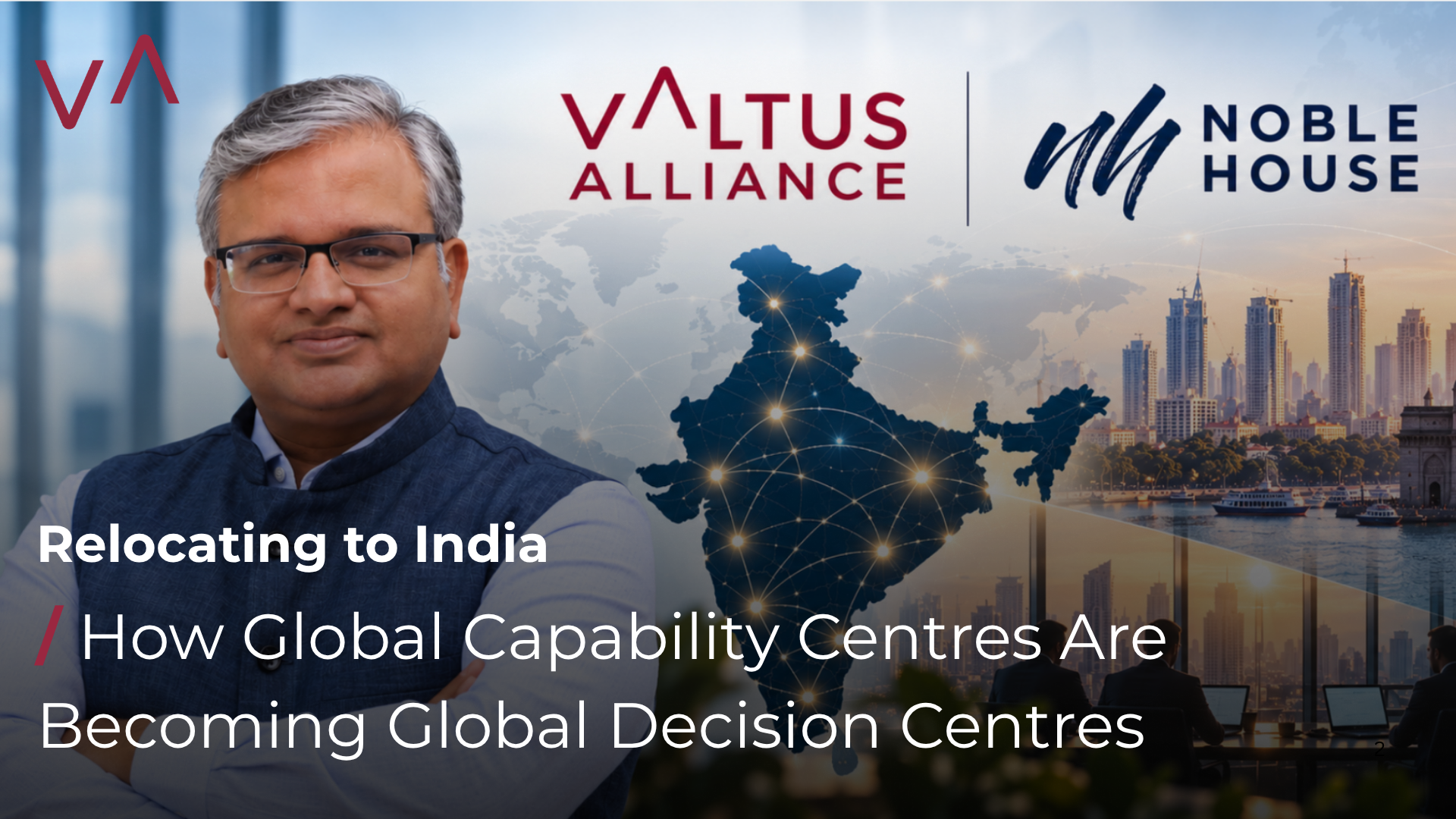
Relocating to India: How Global Capability Centres Are Becoming Global Decision Centres
In this article Sanjay Lakhotia, co-founder and CEO of the Indian Valtus Alliance Partner Noble House Consulting Pte., writes about the use and benefits of Global Capability Centres (GCCs) in India.
India’s Shared Services Revolution
India has been a favourite destination for setting up Global Capability Centres (GCCs) over the last decade, marking a significant upgrade from the traditional call centres and back office processing centres. It is estimated that there are around 2000+ GCCs, employing more than 2.5 million professionals in the sector. The GCCs boast of servicing key functions like Finance & Accounting, HR, Procurement and IT. These earlier used to work as pure support offices but now they are becoming global decision centres for each of the functions.
Who’s Already There: European Names on the Ground
What started as an initiative where American companies setup their operations in India, the European companies were not far behind. European companies that have recently established Global Capability Centres (GCCs) in India include Sanofi, Carlsberg and Lonza. Other European groups – including Allianz, Deutsche Bank, Siemens, SAP, ABB, Bosch, Nestlé, Standard Chartered, Infineon Technologies, ANDRITZ, AVL List and Kapsch TrafficCom – have maintained a longstanding presence in India, in some cases through technology, engineering or shared-services centres.
Why India, Why Now: The Business Case
The four key reasons companies are looking to move to India include:
- Cost: India can offer a fraction of the cost incurred in Europe for running a similar organization.
- Talent Availability: India has a large population of English Speaking, and now a growing population of people speaking other European languages with deep skills in functional areas across the experience spectrum. The people also are familiar with global processes and compliance requirements.
- Scalability: Companies are able to setup and grow from 20 people to 200 and then to 500 people within two years, due to easily available and trainable talent pool.
- Ecosystem: There are a lot of consulting organizations supporting these migrations through a ready to deploy model with flexible arrangements which help convert the idea into reality in quick time.
The Other Side of the Ledger
Some of this definitely leads to a downsizing initiatives in the countries which are losing these processes. There is much debate about job security for people in these countries, and it is important to approach this issue sensitively. When jobs are relocated, it is always important to consider how to get people back into employment. Labour foundations, for example, are an effective means of doing so.
For Interim Managers, both in Europa and in India, relocations create an opportunity. Interim executives can help with knowledge transfer, process documentation, taking up governance roles to manage the businesses both in Europa and in India. Whilst in India the focus will be on training the team, in Europe the focus will be on designing and implementing a fair handover process. It is important to open up new prospects for employees whose roles are being relocated. Without the active involvement of key experts from the transferring organization, a transition cannot succeed.
Companies like Valtus are well positioned to support companies that want to set up Global Capacity Centres abroad through their partners and interim managers around the world.
Sometimes companies will also open up opportunities for their own employees to relocate to India to become part of the leadership team in the country and to work with the teams there as expats for 12-24 months or take up even permanent positions in the long term.
Some of the key reasons for experts and managers to move to India include, low cost of living, high quality education, expat communities, healthy business culture and a great learning experience. Some of the cities provide global standard living conditions for people relocating for short or long duration assignments.
A proven mix for setting up Global Capacity Centres is a combination of interim managers, expats and local managers.
How Noble House and Valtus Alliance can help
The Noble House team in India and the Valtus Alliance partners in Europe and in the Americas have been instrumental in migrating work from abroad to India for various processes as part of their organization and also helped many companies set up base in India over many years. The capabilities include
- creating a business case for the work relocation
- helping set up the infrastructure, site selection and registrations
- process migration documenttion and redesign
- provide EOR services to start out the process (EOR = Employer of Record, i.e. providing an Indian company)
- help with hiring of the team
- provide managed operations for a few years to scale and then transfer the business on a BOT model (BOT = Build, Operate, Transfer)
- bring in a proprietary AI-enabled technology stack that spans the hiring, migration and compliance lifecycle of the relocation
- set up and execute restructuring concepts including social plans and labour foundations in the countries where capacities are reduced
Technology is fast becoming the biggest differentiator in how GCCs are built, and this is where Noble House adds distinct value beyond process and people. Noble House’s proprietary Applicant Tracking System uses semantic search and GPT-4o powered matching to sharply cut hiring timelines for the teams being built in India, its AI-integrated CRM automates outreach and pipeline management for the business being migrated, and its workforce compliance platform automates statutory tracking and reporting so that companies scaling from 20 to 500 people are not left building this compliance backbone from scratch.
Companies partnering with Valtus Alliance and Noble House get more than an execution partner for the relocation – they get a technology partner who can help them build an AI-native GCC from day one, rather than retrofitting AI into a legacy back-office model years later.
Valtus Alliance is able to provide the right skill sets in both the countries, the home country from where the work has to move and the host country through its vast network of partners and interim managers which covers more than 30 countries worldwide with a strong presence in all of Europe.
Global Decision Centres in India
India’s role in the global economy is undergoing a profound transformation. What began with the relocation of call centres and routine back-office processes has increasingly evolved into a network of Global Capability Centres (GCCs) that combine technology, engineering and specialised corporate functions—and, in some cases, exercise global decision-making authority. With India’s economy expected to grow by approximately 6–7 per cent in 2026, alongside the continued expansion of its manufacturing, technology and services sectors, the country is likely to host a growing number of global centres of expertise and decision-making over the coming decade. Bajaj Auto’s acquisition of control over the Austrian motorcycle manufacturer KTM illustrates this broader shift: Indian companies are no longer merely recipients of relocated activities, but are increasingly becoming influential investors, owners and strategic decision-makers in the global economy