

Shaping a new way of working
As the business environment around companies continues to change rapidly, organizations are increasingly turning their attention to interim management – the practice of bringing experienced external executives into leadership roles for a fixed period of time to drive transformation and address critical business challenges.
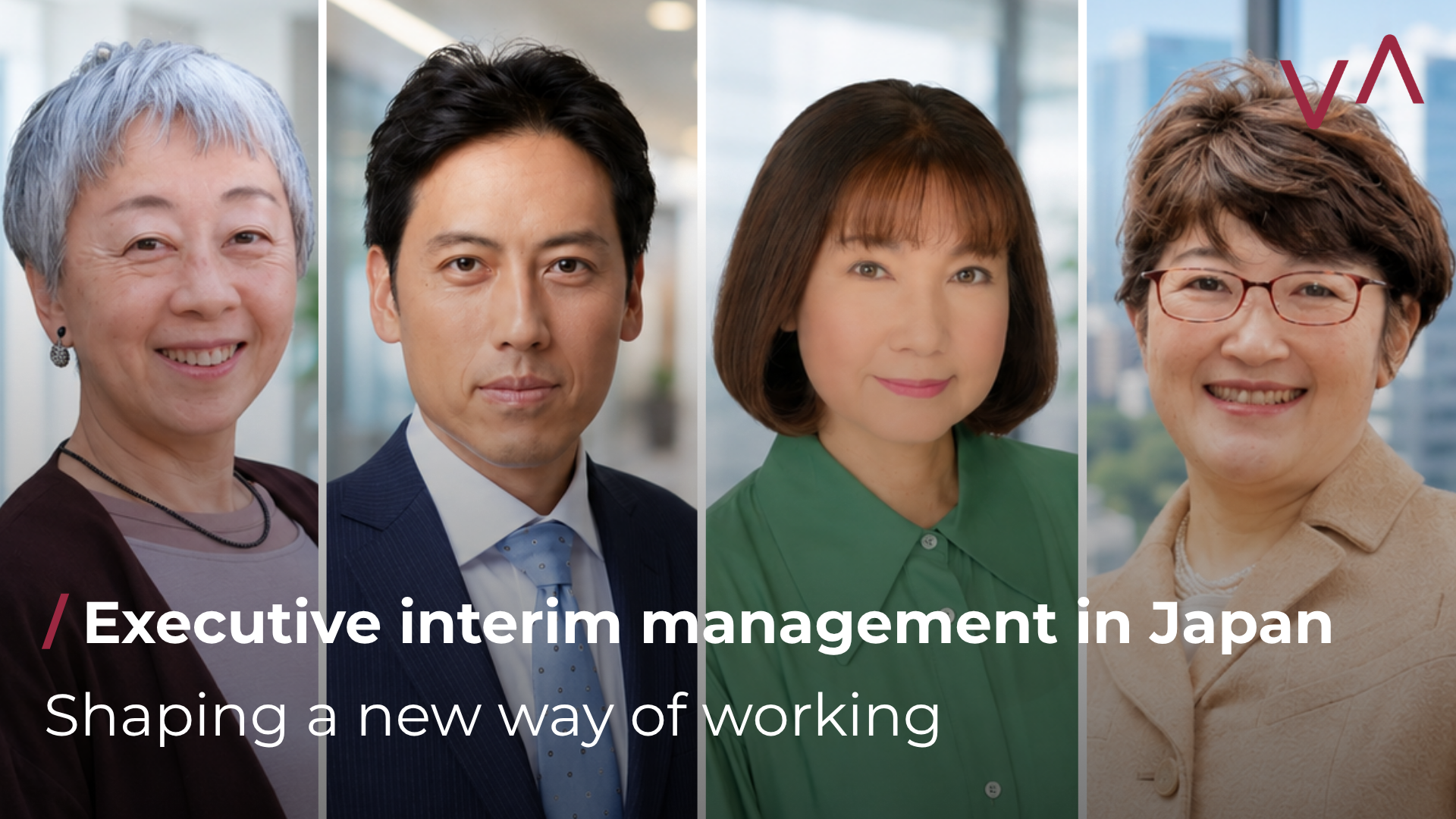
In Japan, this model is still in an early stage of wider recognition, but interest is growing. To explore both the current state and future potential of interim management in the Japanese market, four board members of the Interim Management Association of Japan (IMAJ) came together for this interview. They also reflect on the motivations behind establishing the association and the role it aims to play in shaping a new leadership ecosystem.
- Representative Director – Kuniko Kitsuda
- Director – Atsuko Minatoya
- Director – Mari Tanaka
- Director – Hajime Baba
First, could you tell us what led each of you to become a board member?
Baba: I run a business that introduces interim managers to companies, and through that work I began hearing more and more people say, “I’d like to work in an interim role.”
While our company primarily serves corporate clients, I started thinking about whether we could also create something that would benefit individuals – the people who actually work as interim managers. That was really the starting point for establishing the association.
Tanaka: After working in sales and customer service, I became involved in supporting corporate talent development and HR initiatives at an HR-related company. Through that experience, I came to feel that experienced mid- and senior-career professionals with management backgrounds should have access to more flexible ways of working.
I believe interim management has the potential to become one of those major options, and I wanted to contribute in whatever way I could.
Kitsuda: The role of an interim manager is unique because the objectives and timeframe are so clearly defined. It’s very straightforward to see exactly how much you can contribute within that window. As the effectiveness of this model becomes more widely recognized, I sometimes find myself thinking, “Depending on the organization’s goals or stage of growth, why couldn’t everyone be an interim professional?” One of my main interests right now is using the Association’s activities to explore this kind of working style with all of you.
Minatoya: Through my experience in marketing and team management, I became increasingly interested in people and organizations. During that time, I repeatedly saw how an organization could almost grind to a halt when a manager suddenly left.
I felt interim management could play an important role in filling that “gap period” and keeping the business moving forward. So when I was approached about becoming a board member, I was happy to accept.
There are still many people in Japan who are unfamiliar with interim management, aren’t there?
Minatoya: I actually think the need already exists. It’s just not widely recognized yet.
For example, I know companies where a department head resigned and operations nearly stalled as a result. Situations like that are probably more common than people realize. But the idea of “bringing in an outside specialist on a temporary basis” still hasn’t fully taken hold.
Kitsuda: The term “interim” might not be mainstream yet, but the concept has been around in various forms for a long time. For example, do you remember having substitute teachers in elementary school – perhaps covering for someone on maternity leave? Even as a child, I remember thinking, “What a wonderful system.” Even though they were only there for a limited time, they could jump right in and teach a great class. Plus, as students, we felt a little spark of excitement – like, “Hey, a new teacher’s here!”
Interim management feels very similar to that. It’s not just about being a “relief pitcher” to fill a gap; it’s about a professional appearing exactly when they are needed. Because the engagement is time-bound, they bring fresh perspectives and a healthy sense of momentum to the organization. That’s the kind of positive impact I want us to have.
In Japanese companies, management vacancies are often filled through internal transfers.
Baba: That’s right. In the past, companies could get by with moves like, “Well, they’re already at the department-head level, so they can probably handle another division too.” But going forward, I think we’re entering an era where specialized expertise – whether in HR, marketing, or another field – will become increasingly important.
Tanaka: The traditional patchwork-style internal transfer of talent is reaching its limits. Relocation-based transfers are also much harder to implement than they used to be, and we increasingly hear about people taking on multiple roles because no successor can be found.
If professionals with deep expertise and management capability could join organizations externally – not only as replacements, but perhaps even in supporting or advisory capacities – that could be a major advantage for companies.
Could you tell us about the membership of the IMAJ?
Minatoya: Our members include people who are interested in becoming interim managers, as well as those who want to pursue interim management professionally. Through our supporting companies, members can explore work opportunities, and with assistance from partner organizations, they can also establish the infrastructure needed to work independently. That’s the kind of framework we hope to provide as an association.
But beyond simply offering services, what may matter most is creating a community among members themselves.
Kitsuda: To be honest, we don’t have all the final answers yet on how interim management should best be utilized in the Japanese market. Rather than providing a set manual, we want the Association to be a place where we bring together real-life “I tried this and it worked” experiences so we can all learn from each other.
Tanaka: Exactly. A community where people can openly discuss things like, “This part was challenging,” or “This approach worked well.”
In the future, I think it would be fascinating if not only professionals on the working side, but companies themselves could participate and learn together as well.
Baba: There’s also a unique challenge that comes with entering a company as external talent and taking part in management. It’s very different from working as an internal employee. Each engagement means stepping into a new environment, new relationships, and a different corporate culture – essentially starting from zero every time. And often, there’s no one else in the same position you can turn to for advice.
At the same time, you’re expected to deliver results as a manager while also bringing the unique perspective that only an outsider can offer – including, at times, questioning what has become “common sense” within the organization.
That’s exactly why I believe it’s important to have a place where people in similar positions can share experiences and learn from one another.
Finally, what would you like to achieve through IMAJ?
Minatoya: I’m naturally a very curious person. If the association’s activities can genuinely contribute to society, then I’d love to help make that happen and connect with all kinds of people along the way.
Kitsuda: I hope our members feel inspired to suggest new ideas, like “What if we tried it this way?”
I recently read an article somewhere that said, “If you run an association with multiple people, you’ll inevitably run into conflict.” Well, that just made me want to prove them wrong and make it a success! (Laughs)
In fact, talking with the four board members now, I can already feel that our different viewpoints are leading to better ideas and real results. I want to prove that when you bring together “mature” adults – those who are well-seasoned both professionally and personally – you can create something truly extraordinary. I’m looking forward to proving that alongside all of you.
Tanaka: I hope more people will come to feel that it’s okay not to spend their entire career at a single company until retirement. Sometimes people have to change the way they work because of family circumstances or other life events.
Even then, I hope we can create a society where people feel, “There’s still a place where my skills and experience are needed.”
Baba: Ten years from now, I’d love for more people to look back and say, “I’m really glad this way of working became normal.” I hope this association can help lay the groundwork for that future.