


The market remains stable at around €263 million, while the number of interim managers is rising and utilisation rates are declining.
The Austrian interim management market had a volume of approximately €263 million in 2025, including provider margins, remaining at the previous year’s level. Although more assignments were recorded than in the previous year, they were shorter in duration. These findings are based on a meta-study by VALTUS Management Factory, drawing on five market surveys and its own data.
Key figures for 2025:
- Market volume: Approximately €263 million, including provider margins
- Interim managers: Approximately 1,600, although not all work exclusively in interim management
- Assignments: 1,100–1,200 per year (2024: 1,000–1,100 assignments)
- Average assignment duration: 9.5 months
- Daily rate: Approximately €1,250 on average, excluding provider margins
- Utilisation rate according to the survey: 64%. The rate has declined every year since 2022, when it stood at 70%, and is significantly below the level in Germany (79%)
- Without an assignment: 16% of interim managers in Austria did not undertake a single assignment in 2025 (2023: 6%)
- Reasons for assignments: Restructuring and turnaround situations account for 37% of assignments, while vacancy cover has fallen to just 15% (2023: 24%)
- Assignments brokered through providers: 31% of all assignments; provider margins are approximately 30%
- Executive Interim Management (C-level): 25% of all assignments, equivalent to approximately 290 assignments per year and a market volume of around €97 million
How large is the interim management market in Austria?
In 2025, approximately 1,600 interim managers in Austria completed between 1,100 and 1,200 assignments, generating a market volume of around €263 million. The number of assignments increased compared with 2024, but their duration decreased. Daily rates and the share of assignments brokered through providers declined slightly. Utilisation rates have fallen every year since 2022, while an increasing number of interim managers are unable to secure assignments.
| Key Figures for Austria | 2024 | 2025 | Change |
| Market Volume Including Provider Margins | ~ 263 Mio. € | ~ 263 Mio. € | stable |
| Interim Manager | ~ 1.500 | ~ 1.600 | +7 % |
| Assignments per Year | 1.000–1.100 | 1.100 – 1.200 | +10 % |
| Average Assignment Duration | ca. 10,5 Months | ca. 9,5 Months | −1 Month |
| Daily Rate Excluding Provider Margins | 1.275 € | 1.250 € | −2,0 % |
| Key Figures for Austria | 2024 | 2025 | Change |
| Share of Assignments Brokered Through Providers | 33 % | 31 % | −2 Percentage points |
| Provider Margin | ca. 30 % | ca. 30 % | unchanged |
| Utilisation Rate of Active Interim Managers (Survey Data) | 65 % | 64 % | −1 Percentage points |
| Interim Managers Without Assignments During the Year | 11 % | 16 % | +5 Percentage points |
Market volume is calculated by multiplying the number of assignments by the number of billable days and the daily rate. We assume 17 billable days per month, equivalent to approximately 162 days per assignment (2024: approximately 178 days). The weighted average daily rate, including provider margins, is around €1,416, as just under one-third of all assignments are brokered through providers.
The Austrian economy grew by 0.8% in real terms in 2025, while prices rose by 3.6% (WIFO). A market that remains nominally unchanged at €263 million therefore represents a real-terms decline. This is largely attributable to the tight budgets faced by many companies in 2025. Assignment durations are decreasing as companies under cost pressure commission more clearly defined projects and increasingly engage interim managers on a part-time basis. Daily rates in interim management are also declining because supply exceeds demand.
According to surveys, utilisation rates among interim managers have been falling for several years, declining from 70% in 2022 to 67%, then 65%, and finally 64% in 2025 (INIMA). At the same time, the proportion of interim managers who did not undertake a single assignment during the year rose from 6% in 2023 to 11% in 2024 and 16% in 2025 (Bühler Interim Management).
Based on our calculations, each of the approximately 1,600 interim managers in Austria bills an average of around 116 days per year. This corresponds to a utilisation rate of 53%, assuming 220 working days per year. Surveys report higher utilisation rates because they focus on active association members and interim managers from provider talent pools. Our estimate also includes occasional and part-time interim managers, whose numbers have increased recently.
In any case, the supply of interim managers in Austria exceeds demand, and this imbalance is growing. The number of unemployed executives aged 50 and over is rising, industrial job cuts are leaving their mark, and the large cohorts approaching retirement are further increasing the supply of potential interim managers. In addition, the autonomy and flexibility of interim management appeal to many senior executives who have already established their careers and no longer feel the need to prove themselves.
Where do the figures come from?
There are no official statistics on interim management in Austria. VALTUS Management Factory has therefore analysed five market surveys published in 2026 and cross-checked their findings against its own talent pool and CRM data. The VALTUS Management Factory talent pool comprises approximately 400 interim managers, primarily at C-level and C-1 level.
| Source | Survey | Respondents | Reference |
| INIMA European Survey 2026 (Austrian figures based on the DÖIM member survey) | January 2026 | Around 850 interim managers across 10 countries | Austria, Europe |
| Bühler Interim Management: The Austrian Interim Management Market 2026 | February 2026 | 136 interim managers | Austria |
| AIMP DACH Market Study 2026 | 2026 | 19 providers, 119 clients and approximately 650 interim managers | DACH |
| DDIM Market Study 2026 | 12/2025 – 01/2026 | Approximately 800 interim managers and 28 providers | Germany |
| Heuse Interim: Interim Management Market Trends 2025 | 2026 | 707 interim managers | DACH, mostly Germany |
The studies differ considerably in some areas. The largest discrepancy concerns market volume: the AIMP DACH Market Study 2026 puts the Austrian market at €421 million, with 2,808 interim managers (2024: €257 million and 1,508 interim managers). This increase is almost entirely attributable to the higher number of available interim managers. However, according to INIMA and Bühler Interim Management, utilisation rates and the number of assignments per manager have declined. We estimate the market at approximately 1,600 interim managers and a volume of around €263 million.
The surveys also indicate shorter assignment durations. INIMA reports an average of around eight months for Austria (2024: 9.8 months). For Germany, DDIM reports average durations of 10.7 months, down from 12.1 months, for assignments awarded directly, and 7.1 months, down from 8.7 months, for assignments brokered through providers. For 2025, we estimate an average assignment duration of 9.5 months (2024: 10.5 months).
All market figures are therefore estimates. Figures taken directly from studies, values derived from multiple sources, and VALTUS Management Factory’s own estimates are identified accordingly. Minor discrepancies due to rounding may occur.
What do Austrian companies use interim managers for?
In 2025, restructuring and turnaround situations were the most common reasons for engaging interim managers, accounting for 37% of all assignments, or approximately 425 per year. Traditional vacancy cover is becoming less significant.
| Reason for Assignment (Austria) | 2023 | 2024 | 2025 |
| Restructuring | 22 % | 18 % | 20 % |
| Turnaround and Restructuring | 14 % | 13 % | 17 % |
| Change Management | 16 % | 21 % | 19 % |
| Vacancy Cover | 24 % | 16 % | 15 % |
| Change of Ownership | 3 % | 1 % | 8 % |
Source: Bühler Interim Management, The Austrian Interim Management Market 2026.
Functions: General management and finance each account for around 30% of assignments. Approximately 75 assignments per year are carried out by Chief Restructuring Officers, who are generally classified within the finance function. Operations, HR and IT each account for around 10%. The remaining 10% is distributed across sales, marketing, quality management, business development, and research and development.
Industries: Mechanical and plant engineering is the leading industry, accounting for 18% of assignments (2024: 11%). This is followed by automotive, chemicals and pharmaceuticals, and retail, each with an 8% share. Assignments in the public sector remain rare in Austria.
Which criteria are relevant to clients when selecting interim managers?
The AIMP DACH Market Study 2026 directly addresses this question, based on a survey of 119 companies. Multiple answers were permitted.
| Criterion | Share |
| Execution and Leadership Skills | 99 % |
| Availability | 97 % |
| Integrity and Commitment | 94 % |
| Technical Expertise | 92 % |
| Experience in Similar Projects | 88 % |
| Flexibility | 87 % |
| Methodological Expertise | 80 % |
| References | 73 % |
| On-Site Presence | 71 % |
| Measurable Value of the Assignment (“Return on Interim Management”) | 67 % |
| Daily Rate / Fee | 63 % |
| Experience in the Relevant Industry | 43 % |
| AI Experience | 28 % |
| Leveraging Professional Networks | 24 % |
The findings of the AIMP survey are consistent with our experience as a provider: the three most important requirements are the ability to drive implementation and lead effectively, rapid availability, and integrity and commitment. Industry experience, a personal network within the industry, and AI expertise are considered less important.
What is the profile of interim managers in Austria, and how do they secure assignments?
The professional backgrounds of interim executives are as diverse as the roles they take on. What they have in common is extensive experience gained in a variety of corporate situations, whether through a broad leadership career or many years in management consulting.
In Austria, 94% of interim executives are over the age of 50. How does the oversupply of interim managers identified above align with the current shortage of skilled workers? The two are not mutually exclusive: the shortage concerns skilled professionals, not executives over 50.
Women account for 15% of interim managers in Austria, in line with the European average. Within the VALTUS Management Factory talent pool, the share is 17%.
A total of 41% of interim managers secure assignments through personal contacts, while 31% do so through providers. Online platforms continue to play only a minor role in assignment sourcing: fewer than 5% of assignments are secured through online portals, LinkedIn and other social networks. This share is largely limited to junior and middle management positions.
Strong professional expertise, resilience and the ability to perform under pressure are essential prerequisites for interim management. In Executive Interim Management, these are complemented by strong interpersonal and communication skills, as stakeholder management is a core responsibility in critical corporate situations.
Across the DACH region, 45% of interim managers use AI in their projects, up from 26% in 2024 (Heuse Interim).
How does Austria compare with Germany and Switzerland?
Interim managers in Austria charge approximately 4% less than their counterparts in Germany and have significantly lower utilisation rates. A smaller proportion of assignments in Austria are brokered through providers than in Germany.
| 2025 Figures | Austria | Germany | Switzerland |
| Daily Rate | 1.250 € | 1.297 € | 1.509 € |
| Utilisation Rate | 64 % | 79 % | 60 % |
| 2025 Figures | Austria | Germany | Switzerland |
| Share of Assignments Brokered Through Providers | 31 % | 40 % | – |
| Average Assignment Duration | 9,5 Months | 10,7 Months | – |
| Interim Managers | ~ 1.600 | ~ 12.250 | ~ 2.000 |
| Market Volume | ~ 263 Mio. € | 2,47 Mrd. € | ~ 405 Mio. € |
Sources: Austria: VALTUS Management Factory meta-study. Germany: DDIM Market Study 2026 (utilisation measured against each manager’s individual maximum capacity). Switzerland: Daily rates and utilisation based on the INIMA European Survey 2026. The AIMP DACH Market Study 2026 reports 2,875 interim managers and a market volume of €659 million for Switzerland. We consider these figures too high and estimate that Switzerland has around 2,000 interim managers, representing a market volume of approximately €405 million.
How large is the Executive Interim Management market in Austria?
According to our estimates, Executive Interim Management accounts for approximately 290 assignments, or 25% of all assignments. Due to higher daily rates, this segment represents around 37% of the total market volume, equivalent to approximately €97 million, including provider margins.
The approximately 290 assignments per year involve senior executive positions, including managing directors, board members, CFOs, COOs, CROs, CTOs, CIOs and CHROs.
| Level | Share of Assignments in 2025 | Assignments per Year |
| C-Level (Managing Directors, Board Members, CFOs, COOs, CROs, CIOs, CHROs) | 25 % | ~ 290 |
| Department, Division and Team Management (2nd to 4th Management Levels) | 45 % | ~ 520 |
| Programme and Project Management | 18 % | ~ 210 |
| Staff, Expert and Advisory Roles | 12 % | ~ 140 |
| Executive Interim Management in Austria | 2025 |
| Assignments | ~ 290 |
| Daily Rate Excluding Provider Margins | ~ 1.850 € |
| Market Volume | ~ 97 Mio. € |
| Of Which, Brokered Through Providers | ~ 38 Mio. € |
We deliberately estimate the C-level share at a lower level than reported by interim managers themselves (INIMA Austria 2026: 38%). Our calculation includes only genuine managing director and board-level positions in medium-sized companies and large corporations. The daily rate of approximately €1,850 is based on the rule of thumb of dividing the gross annual salary by 100: a CFO earning €185,000 per year would cost approximately €1,850 per day as an interim manager. For Germany, the DDIM Market Study 2026 reports a 22% share for first-level executive positions.
VALTUS Management Factory is the market leader in Executive Interim Management in Austria. According to our own calculations, the company accounts for approximately one-fifth of the executive-level assignment volume brokered through providers, based on 2025 revenue relative to the estimated market volume.
How will the interim management market develop in 2026?
We expect moderate market growth in 2026, driven by restructuring and turnaround activities. Demand is increasing for interim managers with crisis management and implementation experience, while traditional vacancy cover continues to lose significance.
Five indicators support this outlook:
- Restructuring pressure: 74% of restructuring experts surveyed by EY-Parthenon expect restructuring activity in Austria to continue rising in the first half of 2026, with most anticipating a peak in the second half of the year (EY Restructuring Pulse 2026).
- Insolvencies: KSV1870 recorded 6,810 corporate insolvencies in 2025, an increase of 3.4%, and expects a similar level in 2026.
- Demand for CROs: 63% of restructuring experts from banks and law firms in Germany and Austria report strong demand for Chief Restructuring Officers, while 80% consider management teams’ crisis management experience to be limited (Wieselhuber, Restructuring and Turnaround Barometer 1/2026).
- Companies: 31% of Austrian interim managers rate companies’ willingness to engage interim managers as high, up from 21% in the previous year (Bühler 2026).
- Demand throughout the year: In Germany, 68.7% of interim managers were on assignment in August 2026, compared with around 60% at the beginning of the year (DDIM flash survey).
Demand is particularly strong for managing director and executive roles, finance and restructuring, with programme and project management for transformation initiatives also becoming increasingly important. Assignments in HR and ESG are declining or increasingly being offered on a part-time basis.
According to the DDIM flash survey of August 2026, daily rates in Germany are rising slightly, from €1,297 per day in 2025 to €1,320 in 2026, while average assignment duration is declining once again in 2026. Interim managers and providers view overall market developments in the second half of 2026 positively.
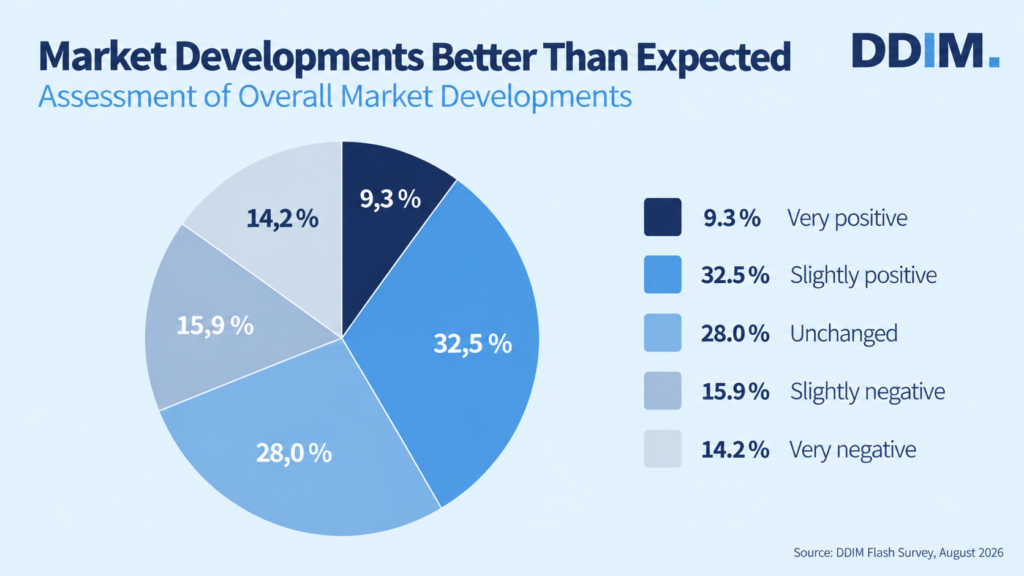
For the Austrian market, VALTUS Management Factory can confirm this trend: demand for interim executives remained robust in Q3 2026.
Sources
- INIMA European Interim Management Survey 2026 (Austrian figures based on the DÖIM survey), inima.management
- Bühler Interim Management: The Austrian Interim Management Market 2026, 8 April 2026
- AIMP DACH Market Study 2026
- DDIM Market Study 2026, as of 17 March 2026, and the DDIM Flash Survey, August 2026
- Heuse Interim: Interim Management Market Trends 2025
- EY-Parthenon Restructuring Pulse 2026
- KSV1870 Corporate Insolvency Statistics 2025
- Dr. Wieselhuber & Partner: Restructuring and Turnaround Barometer 1/2026
- The Austrian Interim Management Market – Meta-study by VALTUS Management Factory, 29 May 2025
- VALTUS Management Factory’s own data (talent pool and CRM)