

Why Local Execution Matters in Poland, Hungary, Romania, Slovakia and Czech Republic
At Valtus Alliance, we rely on an international network of restructuring experts because legal frameworks, creditor behavior, labor expectations, and management cultures differ significantly from one country to another.
This is especially true in Central and Eastern Europe, where many companies are foreign-owned subsidiaries operating under local legal systems, local stakeholder dynamics, and local management cultures that headquarters may not fully understand.
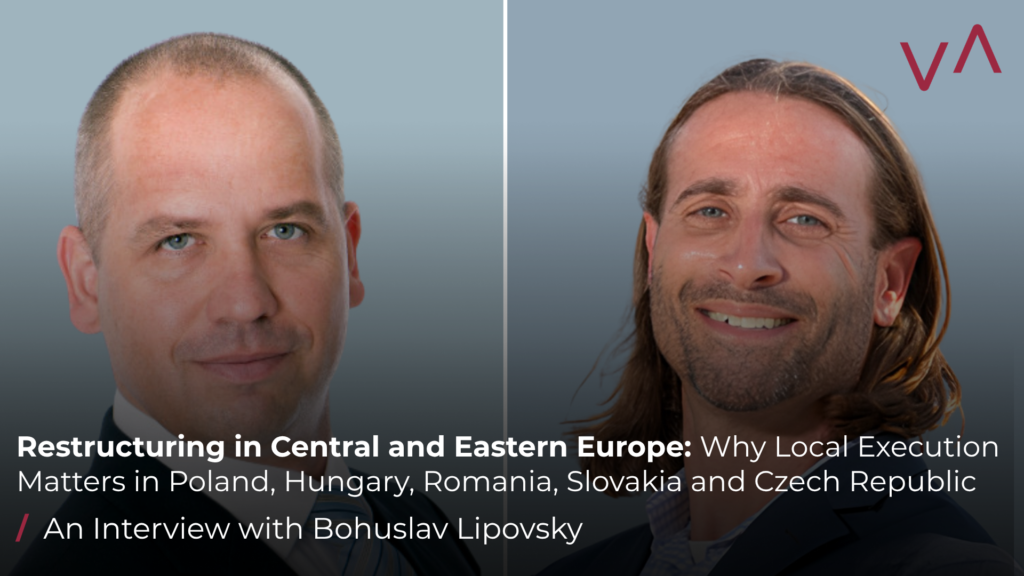
In this interview, Joe Poling, President & CRO of Think Consulting in the United States, speaks with Bohuslav Lipovsky, Founder of CE Interim, about restructuring in Central and Eastern Europe, with a focus on Poland, Hungary, Romania, Slovakia and Czech Republic.
Bohuslav brings a deeply practical perspective to restructuring. His career has followed the transformation of Central and Eastern Europe itself. Early on, he experienced the wave of restructurings and insolvencies that followed the transition from centrally planned economies to market economies. Later, after moving to Germany, he joined a large corporation that went through restructuring and was eventually sold to private equity. As an interim CEO, he took over a group of manufacturing companies emerging from insolvency proceedings, only to see them default again within a few years.
He has also personally led companies through restructuring, called for insolvency when it became unavoidable, and faced intense public pressure, including national media attention and massive trade union strikes, while working to save a company in Slovakia.
This gives him a rare perspective: restructuring is not theory for him. It is something he has seen from the consultant’s chair, the corporate side, the interim manager’s seat, and the CEO’s office during crisis.
Bohuslav, how would you describe the restructuring landscape in Central and Eastern Europe today?
Central and Eastern Europe is not one restructuring market. Poland, Hungary, Romania, Slovakia and Czech Republic each have their own legal framework, creditor culture, labor environment, and business habits.
But to understand restructuring in this region, you also need to understand its history.
I started my career as a consultant during a period when Eastern Europe was still dealing with the consequences of moving from centrally planned economies to market economies. There was a wave of restructurings, insolvencies, ownership changes, and painful industrial transformations. Many companies had to learn very quickly what competition, cash discipline, creditor pressure, and market reality really meant.
That experience shaped me. Restructuring in Central and Eastern Europe is never just a technical exercise. It touches identity, jobs, local communities, management culture, and sometimes national pride.
Later in my career, I moved to Germany and joined a large corporation that went through its own restructuring, which eventually resulted in a sale to private equity. That gave me another perspective: how restructuring looks inside a large Western corporate environment, with headquarters pressure, shareholder expectations, professional advisors, banks, and potential buyers all involved.
So when I look at Poland, Hungary, Romania, Slovakia and Czech Republic today, I see a region that has become much more mature, much more professional, and much more integrated into European business. But the restructuring challenge remains the same: you need speed, credibility, and leadership on the ground.
What makes restructuring in Poland, Hungary, Romania, Slovakia and Czech Republic different from Western Europe?
The legal systems are more developed today than many foreign owners realize. Poland, Hungary, Romania, and Czech Republic all have restructuring and insolvency frameworks that allow companies to act before total collapse. But the law is only one part of the story.
For example, Czech Republic introduced the Act on Preventive Restructuring, effective from September 2023. It gives companies in financial difficulty the possibility to restructure assets, liabilities, and capital structure before insolvency becomes unavoidable. This is important because it gives viable companies a chance to act earlier, not only once the crisis is already irreversible.
Poland has one of the more developed restructuring toolkits in the region. Companies may use arrangement approval proceedings, accelerated arrangement proceedings, arrangement proceedings, remedial proceedings, simplified restructuring proceedings, partial arrangements, and pre-pack sales after bankruptcy declaration. These tools give debtors and creditors several routes depending on the level of distress, creditor structure, and urgency.
Hungary also has several formal options, including bankruptcy proceedings, liquidation proceedings, and preventive restructuring. Preventive restructuring is designed as a voluntary reorganisation-type proceeding based on EU law, while liquidation can be initiated by the debtor, creditors, or in certain cases ex officio.
Romania has classic insolvency, reorganisation, and liquidation procedures, but also pre-insolvency restructuring tools such as restructuring agreements and preventive concordat procedures. These are intended to help viable debtors recover before full insolvency, which is very relevant for foreign owners who still have time to protect the business.
So the tools exist. The question is whether the company uses them early enough and whether the restructuring plan can actually be executed.
The real difference is execution.
In Western Europe, restructuring can often be highly process-driven. In Central and Eastern Europe, process is important, but local trust is just as important. You need to understand how people react when a foreign owner announces restructuring. You need to understand how local managers communicate bad news, how employees interpret silence, how suppliers react to delayed payments, and how quickly a rumor can damage confidence.
I learned this the hard way. As an interim manager, I once took over a group of manufacturing companies out of insolvency proceedings. The companies had already been through a formal process, but the underlying business issues were not fully solved. Unfortunately, within two years, the group defaulted again.
That experience confirmed something very important for me: exiting insolvency does not mean the company has been fixed. A legal restructuring can give breathing space, but only operational restructuring creates a future.
What is the most common mistake companies make in the early stages of a liquidity crisis?
They wait too long, and then they communicate too little.
I have seen this many times. At first, everyone hopes the situation will improve. One customer order will come. One bank extension will be approved. One shareholder decision will arrive. One cost-saving program will be enough.
But restructuring does not wait for people to feel ready.
The legal frameworks in the region increasingly allow companies to act before insolvency. That is a major step forward. In practice, however, many management teams still ignore the early warning signs of corporate distress and delay taking action until they are forced to do so by banks, suppliers, tax authorities, or employees. At that moment, the company no longer controls the timeline.
I was “lucky” enough, if I can use that word, to lead companies myself through restructuring and even to call for insolvency when it became unavoidable. That is one of the most difficult decisions a leader can make. You know it will affect employees, suppliers, families, customers, and the reputation of the company. But if you delay too long, you may destroy the remaining chance to save the business.
In one situation in Slovakia, the restructuring process attracted mainstream media attention for several weeks because of massive trade union strikes. We were trying to save the company, but from the outside it looked like a conflict. That is the reality of restructuring. Even when you are doing the responsible thing, you may be criticized publicly.
This is why timing matters so much. If you act early, you still have options. If you act late, you are forced into decisions under pressure, and everyone around you becomes more emotional.
At what point should an external restructuring expert be brought in?
As soon as the issue is structural, not temporary.
If margins are declining for several months, if working capital is under pressure, if lenders are asking more questions, if suppliers are tightening terms, or if headquarters has lost confidence in the local leadership team, that is already the right moment.
The expert can come in as an interim CEO, CRO, Interim CFO, COO, or plant leader, depending on the nature of the crisis.
But in restructuring, the mandate must be clear. If the interim leader is only an advisor, but nobody has the authority to make decisions, the process will not move fast enough. Restructurings require hands-on interim leadership rather than advisory support, because time is never neutral. Every week without decisive action comes at a cost.
In Central and Eastern Europe, this is especially important because many companies are subsidiaries of larger international groups. The owner may sit abroad, the problem is local, and the people affected by the decision are on the ground. Someone must be able to connect those worlds quickly and credibly.
In a Polish situation, for example, the right route might be an arrangement approval proceeding or accelerated arrangement proceeding. In a Czech situation, preventive restructuring may be relevant before formal insolvency. In Romania, a preventive concordat or restructuring agreement may offer a pre-insolvency path. In Hungary, preventive restructuring may be considered alongside bankruptcy or liquidation options.
But choosing the legal route is only part of the job. The external restructuring expert must also stabilize cash, rebuild lender confidence, lead communication, and make sure the operating business does not collapse while the legal process is being prepared.
For a foreign corporation with a subsidiary in Central and Eastern Europe, what is the best first step in a severe profitability or liquidity crisis?
The first step is a rapid but honest assessment of the situation. This typically includes a robust 13-week cash flow forecast to provide transparency on the company’s actual liquidity position and its short-term funding requirements.
- The first step is a fast but honest diagnostic.
- You need to know three things very quickly.
- Is the business still viable?
- Is the crisis financial, operational, commercial, or leadership-related?
- And who still trusts whom?
The third question is often underestimated. In restructuring, numbers matter, but trust decides whether the plan can be implemented.
A foreign headquarters should not rely only on reports from the local team, and it should not send only a distant consultant from headquarters. It needs someone who understands both sides: the expectations of the parent company and the reality of the local market.
That bridge is critical in Poland, Hungary, Romania, Slovakia and Czech Republic.
The diagnostic must also distinguish between legal distress and operational distress. A company can still be legally viable but operationally broken. Another company may be operationally strong but trapped by a liquidity event, debt maturity, shareholder conflict, or creditor pressure.
This distinction matters because the wrong diagnosis leads to the wrong solution. You do not solve a broken business model only with creditor agreements. And you do not solve a temporary liquidity shock by cutting away the operational capabilities that make the company valuable.
How important are local stakeholders in restructuring?
Very important.
Banks, tax authorities, suppliers, employees, plant managers, local lawyers, customers, and sometimes municipalities can all influence the outcome. Even when the legal framework is clear, stakeholder behavior can differ significantly from country to country.
In Poland, for example, a debtor may have several restructuring paths available, but the real question is creditor support and the credibility of the plan. In Romania, a preventive concordat depends heavily on the restructuring plan and creditor approval. In Hungary, the management body has to prepare a restructuring plan and negotiate it with creditors in restructuring or bankruptcy procedures. (CMS Law)
In some situations, creditors are pragmatic if they see a credible plan. In others, they become defensive very quickly if they feel the company is hiding information. Local communication is essential.
The mistake foreign owners sometimes make is to assume that a restructuring plan approved at headquarters will automatically work locally. It will not. The plan must be translated into local action, local language, local trust, and local timing.
In restructuring, silence is dangerous. If people do not understand what is happening, they create their own version of the story. And once fear spreads, the restructuring becomes much harder to control.
What role does private equity play in restructuring in the region?
Private equity is increasingly important, especially in situations involving underperforming assets, carve-outs, distressed M&A, and operational turnaround.
But Central and Eastern Europe is still different from more mature distressed investment markets. Banks and existing shareholders remain very important, and in many mid-market cases, restructuring is driven by lenders, owners, or foreign parent companies rather than by specialized distressed investors. Covenant pressure within private equity portfolios can also accelerate the need for restructuring measures.
For private equity, the opportunity in the region is significant. There are many industrial assets with strong technical capabilities, skilled employees, and export potential. But some of these companies need a new operating model, stronger financial discipline, or a different leadership culture. This is where interim executives can create value quickly. They are not there to write a report. They are there to stabilize the business, restore control, protect cash, rebuild trust, and execute the plan.
My own experience in Germany, where a corporate restructuring eventually resulted in a sale to private equity, helped me understand how investors look at distressed or underperforming businesses. They are not only looking at today’s crisis. They are looking at what the business could become after leadership, capital structure, governance, and operations are corrected. That is also relevant in CEE. A distressed manufacturing company in Poland, Hungary, Romania, Slovakia or Czech Republic may still have strong people, strong customer relationships, and strong technical know-how. But without decisive restructuring leadership, that value can disappear very quickly.
What type of interim leader is most effective in a CEE restructuring?
The best restructuring leader must be able to stand in the middle of pressure without becoming part of the panic.
They need financial discipline, of course. They must understand cash, creditors, banks, insolvency risk, working capital, and legal deadlines. But that is not enough. They must also understand people. In restructuring, you deal with fear. Employees are afraid for their jobs. Managers are afraid for their reputation. Shareholders are afraid of losing capital. Banks are afraid of losing control. Suppliers are afraid they will not be paid. Trade unions are afraid promises will be broken. If the interim leader only talks in numbers, they will fail. If they only talk emotionally, they will also fail.
I believe the strongest interim restructuring leaders combine calm communication with very firm execution. They can sit with the board in the morning, speak to the bank at noon, walk the factory floor in the afternoon, and face employee representatives in the evening. In Central and Eastern Europe, that ability is essential.You need someone senior enough to speak to headquarters, practical enough to understand the operation, and credible enough to earn trust locally.
An interim restructuring leader also needs to understand the difference between legal milestones and operational milestones. A court decision, creditor vote, restructuring plan, or insolvency filing may be a critical legal step. But the company still needs customers served, production stabilized, suppliers managed, cash protected, and employees led every day. That is where real restructuring happens.
What is often misunderstood about restructuring in manufacturing companies?
Many people think restructuring means cost cutting. Of course, costs matter. Liquidity matters. Headcount may matter. But if restructuring becomes only a cost-cutting exercise, it can destroy the company.
In manufacturing, you must understand the full operational system. You need to look at customers, products, pricing, productivity, quality, scrap, working capital, supply chain, plant leadership, maintenance, energy costs, and the relationship with headquarters. Sometimes the problem is not that the plant is badly managed. Sometimes the problem is that the plant has been given the wrong product mix, the wrong investment logic, the wrong pricing model, or unrealistic expectations from headquarters.
A restructuring leader must be able to separate symptoms from root causes. If you only reduce costs without fixing the business model, the company may look better for a few months. But the crisis will return. This is why I am cautious when people say, “The company has already been restructured.” My question is always: legally restructured, financially restructured, or operationally restructured?
Those are not the same thing.
Which lesson from your career has shaped your view of restructuring the most?
The biggest lesson is that restructuring is not finished when the formal process is finished.
A company can exit insolvency and still be weak. It can sign an agreement with creditors and still have the wrong business model. It can reduce headcount and still lack competitiveness. It can survive today and still default again tomorrow. I have seen that happen.
This is why I always separate legal restructuring from real restructuring. Legal restructuring gives you a framework. Real restructuring changes how the company works.
Real restructuring asks difficult questions.
- Which products should we stop?
- Which customers are unprofitable?
- Which managers can lead the next phase?
- Which sites are viable?
- Which promises can we honestly keep?
- Where is the cash really going?
- What must change permanently?
It is not pleasant work. But if you do it properly, you can save value, save jobs, and give the company a real chance.
What is your final advice to foreign owners facing a restructuring situation in Poland, Hungary, Romania, Slovakia or Czech Republic?
Do not treat Central and Eastern Europe restructuring as a remote-control exercise from headquarters.
Poland, Hungary, Romania, Slovakia and Czech Republic are mature business environments, but they require local understanding. You need someone who can connect the expectations of the foreign owner with the reality of the local company.
And please, act early.
The region now offers more structured restructuring tools than many owners realize. Czech Republic has preventive restructuring. Poland has several arrangement and remedial tools. Hungary has bankruptcy, liquidation, and preventive restructuring procedures. Romania has insolvency, reorganisation, liquidation, restructuring agreements, and preventive concordat options.
But no legal tool saves a company by itself. I have seen restructuring from many angles: as a consultant during the post-planned-economy transformation, as a corporate manager in Germany during a restructuring that led to private equity ownership, as an interim manager taking over companies from insolvency, and as a leader personally responsible for calling insolvency and facing public pressure.
My conclusion is simple: restructuring is never only about saving a balance sheet. It is about making the right decisions early enough so there is still something to save.
That requires courage, transparency, and leadership on the ground.
About CE Interim
CE Interim provides senior interim executives for companies facing transformation, restructuring, operational crisis, post-merger integration, and cross-border business challenges.
With deep experience across Central and Eastern Europe, CE Interim supports international companies, private equity investors, and family-owned businesses that need immediate leadership capacity in complex situations.
Whether the challenge is liquidity pressure, operational underperformance, leadership gaps, insolvency risk, or restructuring execution, CE Interim delivers experienced interim executives who can step in quickly, stabilize the situation, and lead change on the ground.