

A balance between creditors’ interests and the company’s social functions
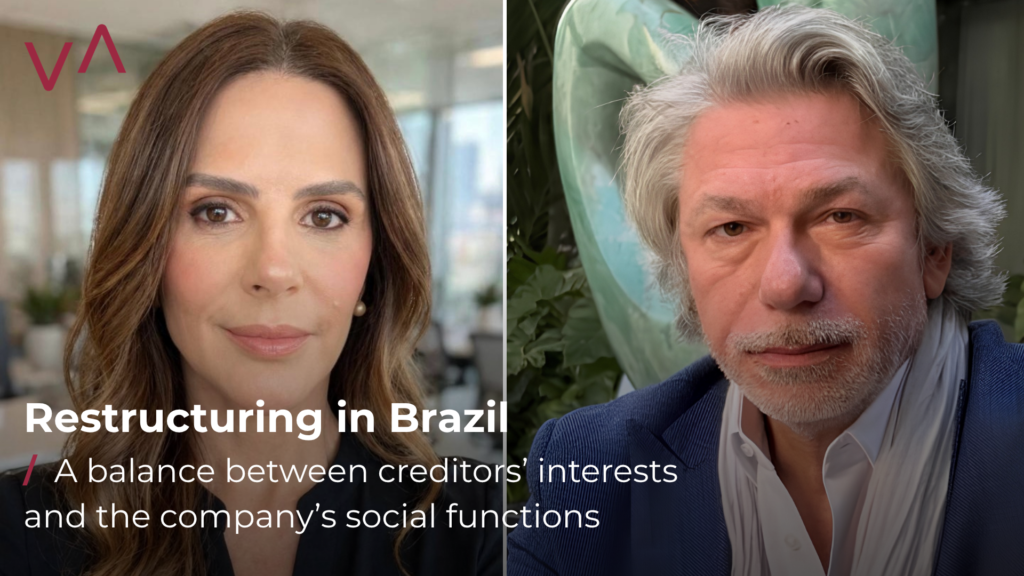
At Valtus Alliance we rely on local restructuring expertise. Marcia Cubas, Associate Partner at Axen Interim Executives in Brazil, discusses her involvement in a corporate restructuring project for a major mining company, with operations across the Southeast, Central-West, and Northeast regions of Brazil. The interview was conducted by Nicolas Touchet, founder and CEO of Axen Interim Executives.
What makes the insolvency and restructuring legal framework unique in Brazil?
Brazil’s insolvency and judicial restructuring framework is considered unique for five reasons:
- Its primary objective is to enable financially distressed companies to overcome their economic and financial crisis, preserving productive activities, jobs, and creditors’ interests while safeguarding the company’s social function.
- The stay period provides broad protection through the suspension of enforcement actions for 180 days, which may be extended for an additional 180 days, except for certain tax and labor claims.
- The restructuring plan is negotiated with creditors, who may propose an alternative plan or even convert debt into equity participation.
- The debtor remains in control of the business under the supervision of a court-appointed judicial administrator, similar to Chapter 11 proceedings in the United States, adapted to the Brazilian legal environment.
- The Brazilian model seeks to be market-oriented by creating a framework for negotiation with judicial protection while incorporating modern tools such as DIP (Debtor-in-Possession) financing.
In your experience, what is the most common mistake companies make in the early stages of a liquidity crisis?
The most common mistake, and often a fatal one, is the failure to engage the entire organization in the restructuring process.
- Communication is often vague, delayed, and unclear, creating uncertainty and reducing productivity.
- Transparency should be established from the outset, clearly explaining the reasons, objectives, and timeline of the restructuring, while creating a safe channel for questions and concerns.
- Another frequent mistake is the lack of objective criteria for evaluations and workforce reductions, with skills either not properly mapped or assessed through subjective standards.
- It is essential to have the right people in place during such a complex period, selected according to clear and relevant criteria.
- Leaders must be trained to handle difficult conversations and manage the instability and uncertainty that accompany a crisis.
- Finally, denial is often a major obstacle, particularly when management attempts to solve the crisis using the same resources and methods that contributed to creating it.
At what point and in what role should an external restructuring specialist be brought in?
A restructuring specialist should be engaged during the acute phase of a crisis, when revenues are declining, business growth has stalled, operational bottlenecks are emerging, and the risk of insolvency becomes apparent. The key is to act without unnecessary delay.
An Interim Restructuring Manager, acting as a Chief Restructuring Officer (CRO), brings an objective perspective and proven methodologies to identify root causes. Free from historical or emotional biases, the CRO operates under a temporary mandate with clearly defined authority. They are able to lead the organization impartially, allowing the executive team to remain focused on running the business.
What is your opinion on the use of judicial protection mechanisms as part of a restructuring strategy?
In Brazil, these protection mechanisms exist and can be highly effective. They function much like a life-support system, providing breathing space and protecting assets when the company remains operationally viable.
However, the Restructuring Plan itself must be of the highest quality, as it is the primary protection mechanism. Its success depends greatly on the leadership of an experienced executive team and highly competent legal advisors.
Could you tell us a bit about your involvement in a corporate restructuring project for a major mining company? What position did you hold and what type of operation was it?
I worked on this project as a corporate management executive at Paranapanema
which is a company transforming mineral copper into metal, operating across the full
copper industrial chain. Paranapanema focuses on the smelting and refining of primary
copper as well as on the production of semi-finished copper and copper aloys.
Can you describe your local restructuring network in Brazil? Who do you regularly collaborate with?
At Axen Interim Management, a member of the Valtus Alliance, we operate through a trusted ecosystem of Interim Managers specializing in operations, finance, and human resources, with diverse CRO profiles.
These are highly experienced executives with strong hands-on expertise, capable of stabilizing cash flow in very short timeframes and leading complex negotiations. They frequently collaborate with top-tier law firms specializing in corporate and insolvency law, ensuring that operational and legal strategies move forward in.