

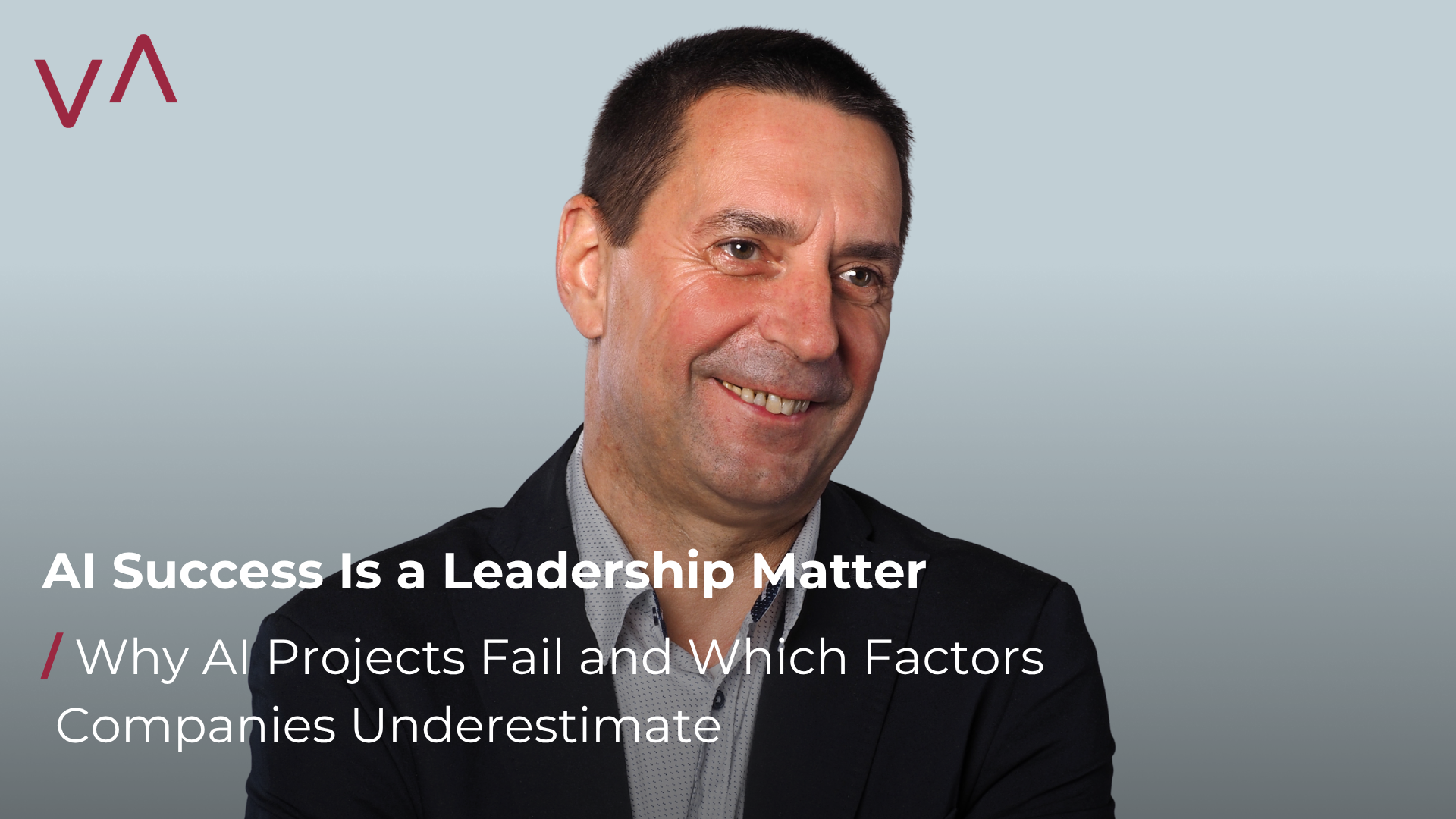
Why AI Projects Fail and Which Factors Companies Underestimate
Artificial intelligence has already arrived in many companies — at least on paper. It is being tested, piloted, discussed, and showcased. Yet in many cases, the actual impact remains limited. According to Wolfgang Frühbauer, certified AI Officer (ÖVE/ÖNORM EN ISO/IEC 17024), the same pattern repeatedly emerges in practice:
there is no precise strategy, resources are planned inadequately, and companies often work with data that is effectively unusable. AI projects rarely fail because of the technology itself; they fail because of poor execution. More often than not, the problem is not the tool — it is the starting point.
Many organizations begin with the wrong question:
“What AI solution should we implement?”
The more important question should be:
“What specific problem are we trying to solve with it?”
Common mistakes in practice include:
- Defining the expected benefit too vaguely (“We want to become more efficient.”)
- Failing to establish a clearly defined use case
- Treating AI as a purely IT-driven initiative rather than a transformation project
- Involving departments and key users too late in the process
- Neglecting employee engagement and communication
- Lacking internal resources for testing, ensuring data quality, and implementation
- Failing to plan for quick, motivating wins
Poor or undefined processes are often the silent killer of AI initiatives. When workflows are unclear, AI amplifies the chaos instead of delivering the expected gains in efficiency.
AI and Resistance
The introduction of artificial intelligence into companies and organizations is no longer merely a technical issue. Increasingly, it becomes clear that the greatest resistance does not stem from inadequate technology or insufficient data, but from human concerns, fears, and reservations. The conflict between artificial intelligence and human intelligence is therefore less technological than cultural and psychological.
Many employees fear being replaced by AI or losing their relevance. These concerns are understandable, as automation and intelligent systems are increasingly taking over tasks once performed exclusively by humans. In most cases, however, AI is not a replacement — it is a tool. It can accelerate processes, identify patterns, and analyze data, but it still requires human interpretation, ethical judgment, and strategic direction.
Another major source of resistance is the fear of losing control. When algorithms begin to support or even make decisions autonomously, people often feel they are losing transparency and influence. Trust in AI systems cannot be achieved through blind acceptance; it is built through transparent processes, clear communication, and the active involvement of those affected in the development and implementation process.
The key therefore lies in an integrative approach. Companies should not position AI “against” human intelligence, but rather as an extension of human capabilities. Training, open dialogue, and a clearly communicated vision help reduce fear and reveal opportunities. When people understand that AI is designed to support rather than replace them, resistance can evolve into active participation.
Ultimately, the success of artificial intelligence will not be determined by the performance of the technology itself, but by people’s willingness to embrace and use it meaningfully. AI reaches its full potential only when it works in harmony with human intelligence — not in opposition to it, whether perceived or real.

Human intelligence is not the enemy of AI. It is the key to its success.
This wording touches on a critical issue — but it can also be framed in a positive way:
AI can only become truly effective when people …
- understand its value,
- trust it,
- are able to integrate it into their daily work, and
- are actively guided through the process by leadership.
This is precisely where many companies struggle:
the technology is introduced, but the transformation process itself is not being led.
Leaders play a crucial role here — not merely by approving AI initiatives, but through their everyday behavior. They should …
- address uncertainty proactively,
- provide direction,
- establish clear priorities,
- allocate the necessary resources, and
- lead by example in the use of AI themselves.
If this leadership behavior is missing, the result is not an AI problem, but a leadership problem with AI symptoms.
Do’s for Successful AI Projects
1. Start with a Real Pain Point
Do not begin with the tool itself, but with a measurable operational problem — for example lost time, high error rates, media disruptions, or knowledge loss.
2. Define a Clear Pilot Project
Start small, but define the framework of the pilot project precisely: objectives, responsibilities, timeline, and success criteria.
3. Involve Employees Early
Employees should not only be included during training sessions, but already during the definition of use cases and the evaluation of processes.
4. Make Leadership Visible
AI initiatives require active sponsorship from leadership — not merely passive approval in the background.
5. Plan Resources Realistically
Resources and responsibilities must be clearly defined. Time allocations for departments, key users, data ownership, and implementation efforts need to be planned properly; otherwise, AI becomes a “side project” with limited chances of success.
6. Measure Success and Ensure Transparency
As with any project, milestones and results must be continuously monitored, evaluated, and discussed.
7. Prioritize Data Quality Over Algorithms
In practice, success is determined by data availability, data quality, and data structure — following the old IT principle: “Garbage in, garbage out.”
The key is to integrate AI into operational processes rather than simply placing AI models alongside existing systems. AI must be systematically embedded into workflows and decision-making structures.
Don’ts in AI Projects
A. Treating AI as a Purely IT Topic
AI is not just an IT issue. It changes processes, roles, and collaboration — not merely software.
B. Expecting Too Much Too Soon
A pilot project is not yet a transformation. Real impact only emerges when AI becomes integrated into everyday operations.
In general, AI initiatives should not be announced with excessive rhetoric as “transformation projects.” Instead, they should be communicated pragmatically as projects aimed at improving efficiency and quality.
Many companies also face the question of whether they should rely on existing market solutions or develop and train their own AI tools internally. There is no universal answer, because every use case is unique. In most situations, the best solution is ultimately a combination of both approaches.
For this reason, it is highly advisable to develop a company’s AI strategy together with an experienced AI professional. Such experts typically have a strong overview of the products and solutions already available on the market, as well as insight into what has proven successful in practice.
A Successful AI Implementation (Case Study)
The objective was to develop an AI voice agent for an HVAC service company with an emergency installation hotline in order to automate job allocation and dispatching.
The implementation required integration of:
- inbound and outbound telephony,
- a knowledge database including equipment management and customer data,
- AI-supported route optimization, and
- live traffic data integration.
The use case was structured as follows:
- Service requests are managed by the AI system.
- Technicians receive assignments directly on their mobile phones, including equipment details, reported malfunctions, and required maintenance information.
- Once a technician accepts the assignment, the AI automatically contacts the customer and provides an estimated arrival time based on live map and traffic data.
- If the customer changes the appointment, the AI reorganizes the technician’s schedule dynamically.
- If the customer is unavailable, the AI arranges a new appointment automatically.
Add-On Functionality
If a customer does not show up, the AI identifies nearby customers and proactively asks whether they would like to move their appointment forward.
The primary challenge during implementation was not technological or AI-related — it was human. Employees initially viewed the concept as unrealistic and doubted its feasibility. In addition, technicians felt observed and monitored during the rollout phase. Naturally, the optimized workflow also resulted in fewer idle periods because working hours were used more efficiently.
This demonstrated that financial incentives played a key role in creating a win-win situation, ultimately leading to acceptance of the AI solution.
Looking back, AI consultant Wolfgang Frühbauer describes the project as “one of the most successful and efficient AI implementations I have seen to date, because management fully supported it from the beginning. The benefits were clearly recognized, the strategy was developed collaboratively, resources were allocated appropriately, and during the rollout the necessary measures were taken to implement the change process with minimal friction.”

The key takeaway from this and many other AI projects is that the return on investment was achieved within a very short period of time — also because funding support in these cases covered between 30 and 50 percent,” says Frühbauer.
Practical Conclusion for AI Implementations in Companies
Most AI projects do not fail because of artificial intelligence itself.
They fail because of a lack of clarity, insufficient change leadership, and limited execution capacity.
Anyone aiming to implement AI successfully must therefore manage two systems simultaneously:
- the technical system (data, tools, security, and integration)
- the human system (trust, communication, roles, and leadership)
This is precisely what distinguishes an AI experiment from genuine AI success.
Wolfgang Frühbauer, MBA
Licensed AI Officer (ÖVE/ÖNORM EN ISO/IEC 17024) – AI Expert – AI Trainer