

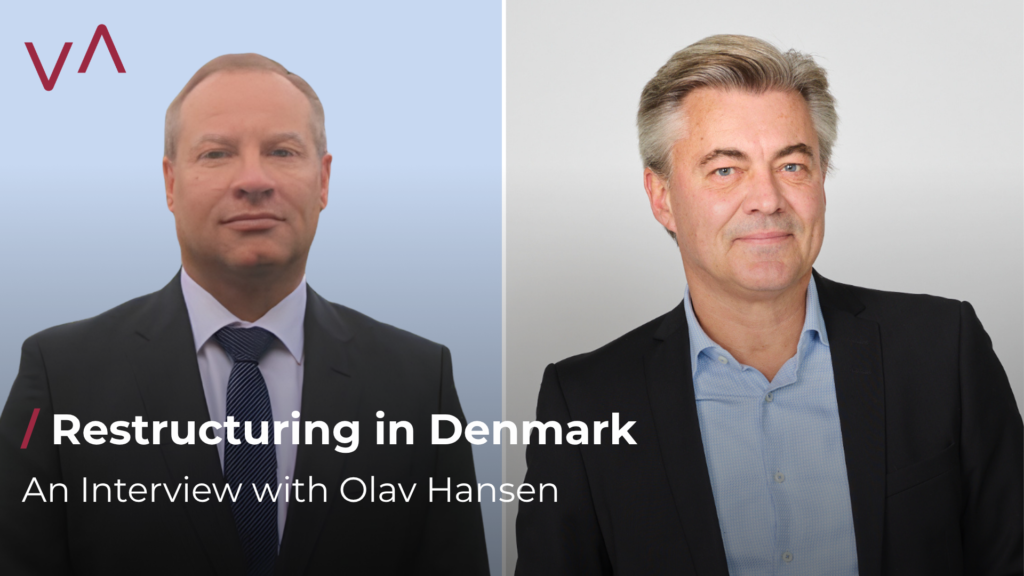
In this interview, Henrik Hojsgaard, partner with Nordic Interim Denmark, interviews International Finance Executive Olav Hansen about restructuring, sharing insights on current challenges, key success factors, and practical experiences from leading transformation and turnaround initiatives.
In your experience, what is the most common mistake companies make in Denmark in the early stages of a liquidity crisis?
In my experience, companies often rely on hope for too long instead of facing reality. Management teams may convince themselves that the situation will improve on its own, which delays difficult but necessary decisions.
Cash flow projections and actual results often start to diverge. At that point, planning and taking action become even more crucial.
The second common mistake is simply acting too slowly. When liquidity starts to become an issue, there is usually still time to take corrective action, but only if management, owners and the board are prepared to address the situation openly and make decisions early. If the board doesn’t act promptly, it may risk becoming personally liable. The longer a company waits, the fewer options remain available.
At what point, and in what role (e.g., consultant, CFO, CRO), should an external restructuring expert be brought in – and who should mandate them (management, board, owners, banks, government)?
The earlier, the better. Once liquidity concerns begin to emerge, an external perspective can help management assess the situation objectively and identify realistic options.
Whether the person comes in as an advisor, CFO, CRO, legal advisor or financial restructuring specialist depends on the situation. However, the initiative should ideally come from the board and the owners. They have a responsibility to ensure that decisions and plans are made on the basis of facts rather than optimism. First and foremost, a restructuring plan needs to be developed to steer the company out of its liquidity crisis. Naturally, such plans vary in complexity depending on the size of the company and the situation it is in. In some situations, lenders may also encourage external involvement, but it is always preferable when the company acts before external pressure forces it to do so.
Do employees in Denmark continue to receive their salaries and bonuses in the event of insolvency or do they lose the entire or part of the wages?
In the Nordic countries, employees are generally well protected through state-backed solutions. It varies from country to country whether a company must first be declared bankrupt in order for employees to receive their salaries, or whether salaries can also be reimbursed if the company enters a restructuring process.
There are specific legal frameworks governing insolvency and bankruptcy proceedings, while employees’ wage claims are protected by government authorities. The exact treatment of bonuses depends on the circumstances and the local legislation, but in general, employee protection is significantly stronger than in many other jurisdictions.
In cases of insolvency or bankruptcy, how do interim managers working in restructuring ensure they receive their remuneration in Denmark?
The most important safeguard is a well-structured contract.
In situations where there is an elevated financial risk, interim managers may seek additional protection through contractual arrangements or bank guarantees. The objective is to ensure that remuneration is protected even if the company enters insolvency proceedings.
In my own assignments, I have always made sure that payment arrangements are clearly defined from the outset, so expectations and responsibilities are transparent for all parties.
Could you describe a recent restructuring and/or turnaround case in your country – or a cross-border case involving the Valtus Alliance?
A recent example was an assignment as Interim CFO for a manufacturing company undergoing a major business transformation.
The company was implementing a new ERP system, restructuring its finance organisation and carrying out several strategic initiatives while addressing financial challenges across the business.
One of the key challenges involved securing sufficient funding for loss-making entities and ensuring that the organisation maintained control over liquidity throughout the transformation. By combining operational improvements with strong financial discipline, we were able to stabilise the business and create a stronger platform for future development.
Which case in your career has most profoundly shaped your view of restructuring – and what did you learn from it?
A recent assignment reinforced something I have learned throughout my career: restructuring is never only about numbers.
The financial analysis is important, but successful transformations depend just as much on communication, leadership and trust. During periods of significant change, there is often a phase where employees feel uncertainty and where progress is difficult to see.
What I learned is that leaders must remain transparent, communicate consistently and continue moving forward even when the organisation is under pressure.
Can you describe your local restructuring network? With whom do you cooperate on a regular basis?
Whenever a situation becomes critical, I work closely with three key stakeholder groups: the board, legal advisors and banking partners.
The board plays a central role in governance and decision-making in accordance with applicable regulations. Lawyers help navigate the legal implications of restructuring, and banks are often critical stakeholders when liquidity becomes a concern. This can, for example, take the form of a bridge financing arrangement until a new owner is found or additional capital has been injected by the existing owners. Private equity funds may also be a viable source of financing.
Beyond that, I work closely with management teams and owners, as successful restructuring requires alignment across all key decision-makers.
Does Denmark support companies in crisis – for example, through specific subsidies or state-backed loans?
Support mechanisms exist, but they are generally more limited than many people expect.
In my view, companies should not base their restructuring plans on the assumption that public support will solve their problems. The primary responsibility remains with management and the board.
State-backed bodies can sometimes provide temporary relief, but long-term solutions must come from addressing the underlying business challenges and creating a sustainable operating model.
Whenever a company is in urgent need of liquidity and a financing solution is put in place, it is normally on expensive terms and conditions.