


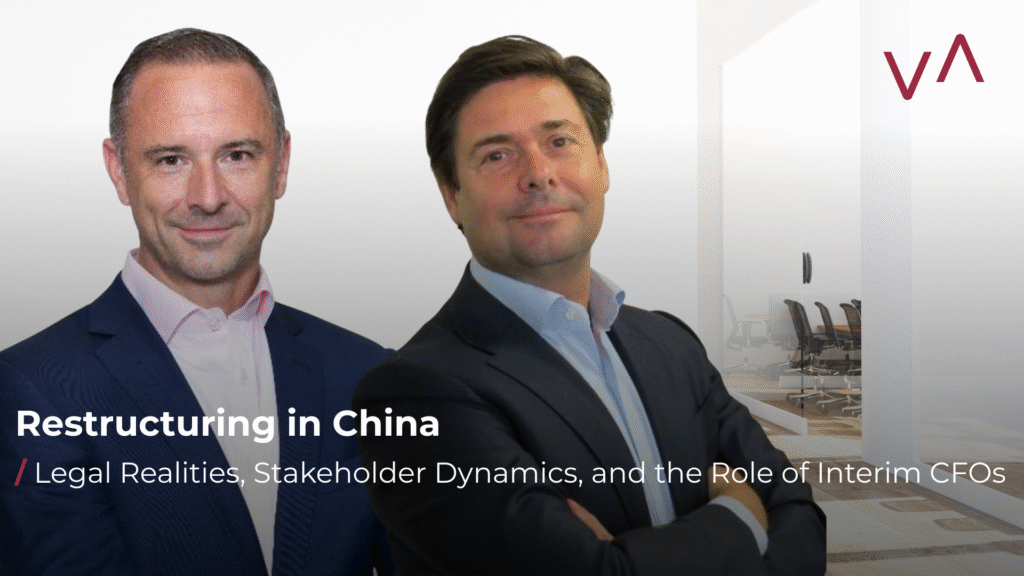
An Interview with Paul Mol, Interim CFO and Founder of Mol & Partners
Valtus Alliance Partner Thaddaeus Mueller speaks with Paul Mol about how interim CFOs navigate restructuring situations in Hong Kong, Mainland China, and Southeast Asia, and how regional legal frameworks, stakeholder expectations, and execution realities shape successful outcomes.
What makes the legal framework for insolvency and restructuring unique in China and Hong Kong?
Hong Kong operates under a common law framework, much like the UK, so it’s relatively creditor-friendly and formal. Restructuring is often pursued via schemes of arrangement or out-of-court workouts, but there’s no direct equivalent to Chapter 11 in the US. There is also no formal debtor-in-possession model or automatic stay; everything hinges on creditor cooperation.
Mainland China, on the other hand, follows the Enterprise Bankruptcy Law (EBL), which has been in place since 2007. While the law is conceptually modern, its application can vary significantly by province and court. There is a pre-restructuring pilot program in some jurisdictions, but it remains underdeveloped.
In China, local governments often play an informal but decisive role in restructuring processes, particularly when employment or social stability is at stake. Unlike Europe, legal predictability can be low, and soft factors like relationships (“guanxi”) often matter just as much as legal merits.
Are there equivalents to protective shield proceedings or early-stage restructuring instruments, like Germany’s StaRUG or the US Chapter 11?
In Hong Kong, the closest equivalent is the scheme of arrangement, which must be approved by a majority in value and number of creditors and sanctioned by the court. However, it doesn’t offer an automatic moratorium like Chapter 11. Companies must apply separately for an injunction or provisional liquidation to gain breathing space.
Mainland China lacks a robust pre-insolvency restructuring framework. There’s no equivalent to Germany’s IDW S6 report or StaRUG. Some courts have piloted pre-restructuring mechanisms, but they lack consistency, and court protection is limited.
In practice, many restructurings in China are negotiated informally with banks, local authorities, and key suppliers. The process is pragmatic but lacks transparency and legal safeguards for all parties.
Do employees in China and Hong Kong continue to receive salaries and bonuses in insolvency?
In Hong Kong, employees are treated as preferential creditors and can also access the Protection of Wages on Insolvency Fund (PWIF). So yes, they typically receive outstanding wages, subject to statutory caps.
In Mainland China, employee claims have statutory priority, but the enforcement varies. In practice, ensuring continued payroll during restructuring often becomes a social and political issue. Local governments may intervene to avoid unrest, particularly in state-linked or larger employers.
How do interim managers secure their remuneration in restructuring cases?
It comes down to mandate structure and clarity. In Hong Kong, professional fees are typically secured through board-approved engagements, sometimes supported by lender consent or management agreements.
In China, it’s more nuanced. Interim managers often negotiate milestone-based or short-term contracts and may include local legal counsel in drafting protections. Getting paid can be difficult if no funds are reserved or if restructuring drags on, so we structure our involvement carefully.
Can you describe your restructuring network in the region?
Over the years, I’ve built a strong network of legal counsel, audit partners, restructuring specialists, corporate secretaries, and government liaisons across Greater China and Southeast Asia. That’s one of the advantages of bringing in an interim CFO early – you don’t just get an individual; you get access to a battle-tested network.
This is especially important in China, where informal influence can matter more than formal authority. Having trusted advisors who know how to navigate local courts, government bureaus, and even banks makes a huge difference.
How efficient is the collaboration between management, creditors, and courts in formal restructuring?
In Hong Kong, it’s structured and relatively efficient, provided you have legal support and creditor alignment. Courts are reliable, and the process is well-established.
In China, collaboration is less institutionalized. Creditors, especially banks, often coordinate with local government. Courts may prioritize job preservation over creditor recovery, especially in politically sensitive industries. As such, negotiations outside court are often more decisive than those inside.
How do you assess the role of relationship banks in these processes?
Relationship with banks are pivotal. In Hong Kong, they act as partners if they trust the company and see a viable plan. But if communication is weak or credibility is lost, they can become the biggest obstacle.
In China, banks take a more conservative, state-aligned position. They’ll often defer to local regulators or government influence. That makes early engagement and transparent planning essential. If banks feel blindsided, the situation escalates quickly.
Does the government support companies in crisis through subsidies or relief programs?
In Hong Kong, government intervention is limited. Some COVID-era programs offered temporary relief, but there’s no long-term safety net for distressed firms.
In China, local governments can and do step in — but selectively. They might offer tax deferrals, reduce compliance pressure, or even broker deals with banks if the employer is significant to local stability. But this isn’t formalized, and it varies widely.
What role does the interim CFO play in aligning stakeholders and ensuring execution?
In crisis, facts matter — but alignment matters more. An interim CFO brings objectivity, credibility, and speed. I focus on clarifying the situation (cash flow, bank covenants, creditor positions), building a realistic action plan, and then driving execution.
Equally important is bridging communication between parties: local management, HQ, banks, auditors, and suppliers. In Asia, where cultural differences and reporting standards vary, this alignment work is critical. You need someone who can both read a spreadsheet and read the room.
Final thought: What have you learned most from managing restructuring across Asia?
That structure matters — but context matters more. Each country, and each crisis, requires a different mix of legal process, negotiation, and cultural fluency.
I’ve learned that fast action, realistic planning, and trust-building are universal. But how you achieve those things — especially in China — depends on more than numbers. It’s about navigating formal and informal systems at the same time. That’s what makes restructuring in this region challenging — and interesting.