

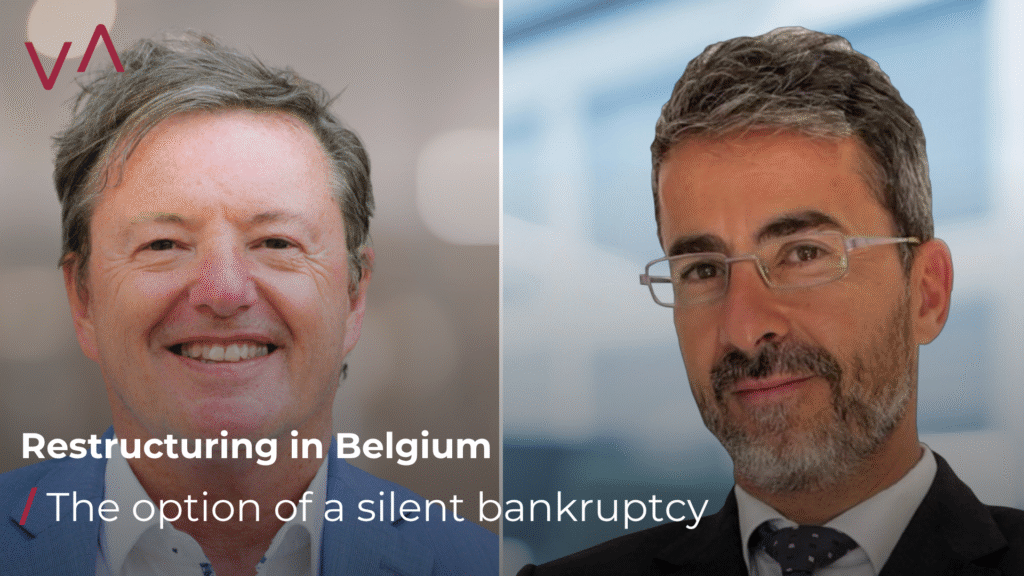
At Valtus Alliance, we rely on a global network of restructuring experts, as legal frameworks and restructuring cultures differ across countries and continents. In this cross-border conversation, Wim De Mulder, partner at VALPEO in Brussels, shares insights from decades of experience with Juan Manuel Gil de Escobar Delgado from Epunto Interim in Madrid.
What makes the legal framework for insolvency and restructuring unique in Belgium?
Under Belgian law, insolvent companies can prepare for bankruptcy confidentially through what is known as a “silent bankruptcy.” This relatively new procedure aims to avoid the negative publicity associated with public bankruptcy and facilitates the transfer of assets or business activities as a going concern. Within a limited timeframe, the debtor negotiates these transfers confidentially and under limited court supervision. If negotiations are successful, a public bankruptcy is initiated, and the transfer is completed shortly thereafter. This procedure is only granted if the debtor demonstrates that preparing the sale in advance supports an orderly liquidation and serves the interests of creditors and employees. If approved, a prospective bankruptcy trustee is appointed for up to 30 days, extendable to a maximum of 60 days.
In your experience, what is the most common mistake companies make in the early stages of a liquidity crisis?
Companies often delay taking action, which significantly reduces their negotiating power and leads to less favorable outcomes when raising capital or cutting costs. Weak accounts receivable management is another frequent issue, as companies fail to collect payments efficiently and effectively finance their customers interest-free while running out of cash themselves. Additionally, ignoring the cash cycle by not maintaining accurate short-term cash flow forecasts can result in overspending. Rapid hiring based on outdated financial projections also worsens the situation. These mistakes can be critical, as a company may appear profitable on paper while still facing a liquidity crisis if cash inflows do not match outflows, a situation often seen in fast-growing businesses.
At what point and in what role should an external restructuring expert be brought in, and who should mandate them?
An external expert such as a CRO or interim CFO should be brought in when the company cannot meet operational cash needs or debt obligations, breaches financial covenants, experiences a significant drop in profitability, or lacks the internal expertise to manage complex turnaround situations. Pressure from stakeholders, such as creditors requiring independent assessments, can also trigger this step. These experts are typically mandated by the board of directors, creditors, management, owners, or even courts. Early action is crucial, as it increases the chances of a successful turnaround. The expert should bring an unbiased perspective, credibility with stakeholders, and the ability to make difficult decisions while working collaboratively with existing management.
Do you have advice for directors of companies in financial distress?
Directors should closely monitor liquidity and solvency, with particular attention to cash flow forecasts and net assets. Increasing the frequency of board meetings is essential to track financial developments and evaluate restructuring measures. Board decisions should be carefully documented to demonstrate that they are made in the company’s best interest. In distress situations, creditor interests take precedence over shareholders. Directors should also be cautious with intra-group transactions, ensure proper stakeholder communication while respecting confidentiality, and seek external advice early if needed.
Could you describe a recent restructuring or turnaround case in Belgium or within the Valtus Alliance network?
One recent mandate involved the recapitalisation and renegotiation of a Belgian portfolio company owned by a UK-based private equity firm. The goal was to reduce debt and secure the company’s continuity. The CRO led financial and legal restructuring efforts, managed liquidity, and negotiated with key stakeholders such as banks, creditors, and investors. At the same time, operational improvements and cost reductions were implemented. Within six months, financial burdens were successfully renegotiated, giving the company more stability and allowing it to continue operating with renewed strength.
How many restructuring managers does VALPEO have in its talent pool?
VALPEO has around 75 restructuring managers, all with strong experience in transformation, post-M&A integration, and crisis management. They are carefully matched to client needs based on leadership capability and complexity requirements. In 2025, the firm completed 14 restructuring assignments.
How efficient is the collaboration between management, creditors, and courts in Belgium?
Collaboration is generally seen as efficient and well-balanced, especially following reforms in 2023 that aligned Belgian law with the EU Restructuring Directive. The framework combines debtor-friendly options with creditor protections, creating a flexible system for rescuing viable businesses.
How established is private equity in restructuring situations in Belgium?
While banks and existing shareholders still dominate in early distress stages, private equity is becoming increasingly important in restructuring. Firms such as Argos Wityu, CIM Capital, and Waterland Private Equity provide capital, transformation expertise, and turnaround support, filling a crucial gap.
How do relationship banks behave during a restructuring process?
Relationship banks can act both as partners and obstacles. When a company is considered viable and operates transparently, banks tend to support restructuring efforts. However, when risks are high or transparency is lacking, they focus on protecting their own balance sheets and may take a more rigid stance.