

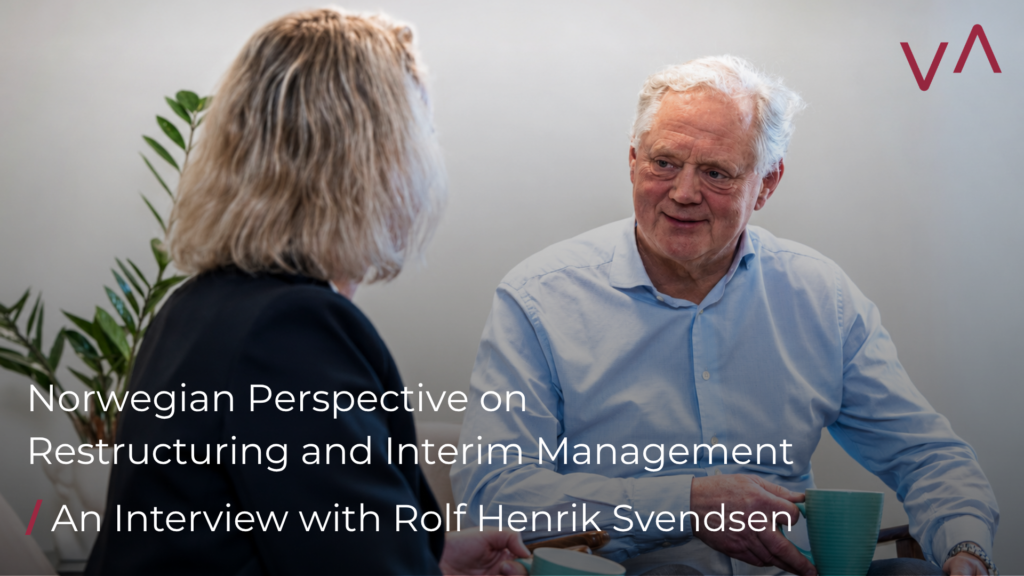
At Valtus Alliance, we rely on a global network of restructuring and transformation experts because legal frameworks, stakeholder dynamics, and restructuring cultures vary significantly across countries and regions. In this cross-border conversation, KJ Lee, Partner at You & Partner in Seoul, speaks with Rolf Henrik Svendsen, Managing Partner of Incepto Interim Management in Oslo and the Norwegian partner of Valtus Alliance.
With more than 25 years of leadership, turnaround, and transformation experience, Rolf Henrik has supported companies across industries facing strategic, operational, and financial challenges. Through Incepto, he works closely with boards, owners, lenders, and management teams to deploy experienced interim executives who help stabilize businesses, lead restructurings, and deliver sustainable change.
What makes the legal framework for insolvency and restructuring unique in Norway?
Norway has traditionally been regarded as a creditor-friendly jurisdiction, but over the last few years the restructuring framework has become more modern and pragmatic. The temporary reconstruction legislation introduced during the pandemic accelerated the development of more flexible restructuring solutions and influenced permanent legislative reforms.
What is particularly Norwegian is the relatively high level of trust and transparency between stakeholders. In many restructurings, constructive dialogue between banks, owners, management, and employees starts early, which can reduce the need for heavily court-driven processes.
In your experience, what is the most common mistake companies make in the early stages of a liquidity crisis?
The most common mistake is waiting too long before acknowledging the seriousness of the situation. Many companies initially treat a structural profitability problem as a temporary liquidity issue and focus only on short-term cash measures.
Another recurring issue is insufficient transparency toward lenders and stakeholders. In Norway, relationship-based banking is still important, and trust can deteriorate quickly if management is perceived as withholding information or reacting too late.
At what point, and in what role, should an external restructuring expert be brought in – and who should mandate them?
An external restructuring expert should ideally be involved before the company reaches a formal insolvency situation. The earlier an independent perspective is introduced, the greater the chance of preserving optionality and stakeholder confidence.
In Norway, the initiative may come from the board, owners, or lending banks, depending on the severity of the crisis. Interim managers are often brought in as CROs, interim CFOs, or CEOs to stabilize operations, establish credibility, and lead difficult stakeholder discussions objectively.
Do employees in your country continue to receive their salaries and bonuses in the event of insolvency?
In Norway, employee protection is relatively strong. Through the state wage guarantee scheme, employees are normally covered for unpaid salary claims up to certain statutory limits if the employer becomes insolvent.
Bonuses are more complicated and depend on contractual obligations and the timing of accrual. Fixed salary obligations are generally prioritized more strongly than discretionary incentive schemes.
Which case in your career has most profoundly shaped your view of restructuring – and what did you learn from it?
One particularly formative experience involved a company where the operational issues were manageable, but the lack of alignment between shareholders and lenders nearly destroyed the restructuring process. It demonstrated that financial restructuring is often less about numbers and more about stakeholder psychology, communication, and trust.
The key lesson was that interim leadership must create clarity and momentum quickly. In uncertain situations, employees and creditors often tolerate difficult decisions if communication is transparent and leadership is visible.
Can you describe your local restructuring network? With whom do you cooperate on a regular basis?
The Norwegian restructuring environment is relatively small and highly relationship-driven. Interim managers typically work closely with restructuring lawyers, audit and advisory firms, banks, private equity investors, turnaround consultants, and insolvency practitioners.
Because the market is compact, reputation and execution capability are extremely important. Most successful restructuring processes rely on trusted interdisciplinary cooperation rather than purely legal or financial solutions.
At Incepto, we maintain a broad network of experienced interim CEOs, CFOs, CROs, transformation leaders, and industry specialists who can be deployed rapidly when companies face operational or financial challenges. Depending on the situation, we often combine interim leadership with specialist advisors to create the right team for a successful turnaround or restructuring process.
In your jurisdiction, how efficient is the collaboration between management, creditors, and courts in formal restructuring proceedings?
Compared with many larger jurisdictions, collaboration in Norway is generally efficient and pragmatic. Formal court proceedings are often less adversarial, and stakeholders usually seek commercially viable compromises where possible.
That said, Norwegian restructuring culture still tends to favor consensual out-of-court solutions. Formal proceedings are often viewed as a last resort rather than the primary restructuring tool.
How established is private equity in Norway with regard to restructuring?
Private equity has become increasingly active in Norwegian restructuring situations, particularly in sectors such as energy, offshore services, real estate, and technology. Well-known Nordic investors such as Summa Equity, Norvestor, Altor, FSN Capital, HitecVision, and EQT have all contributed to the development of professional ownership and transformation capabilities across the region.
However, compared with larger European markets, banks and existing owners still tend to play the dominant role in many restructurings. We are nevertheless seeing growing interest from special situations investors and funds looking at distressed and turnaround opportunities in the Nordic market.
How do you assess the role of relationship banks during a restructuring process – more as partners, obstacles, or both?
Relationship banks in Norway can be both highly constructive partners and demanding stakeholders. Much depends on the credibility of management and the quality of the restructuring plan presented.
In my experience, Norwegian banks are generally pragmatic if they believe management is realistic, transparent, and willing to act decisively. Once trust is lost, however, the process becomes significantly more difficult.
As Norway’s interim management market continues to mature, we see increasing demand for experienced executives who can step into critical leadership roles at short notice and help companies navigate periods of transformation, restructuring, and growth.