


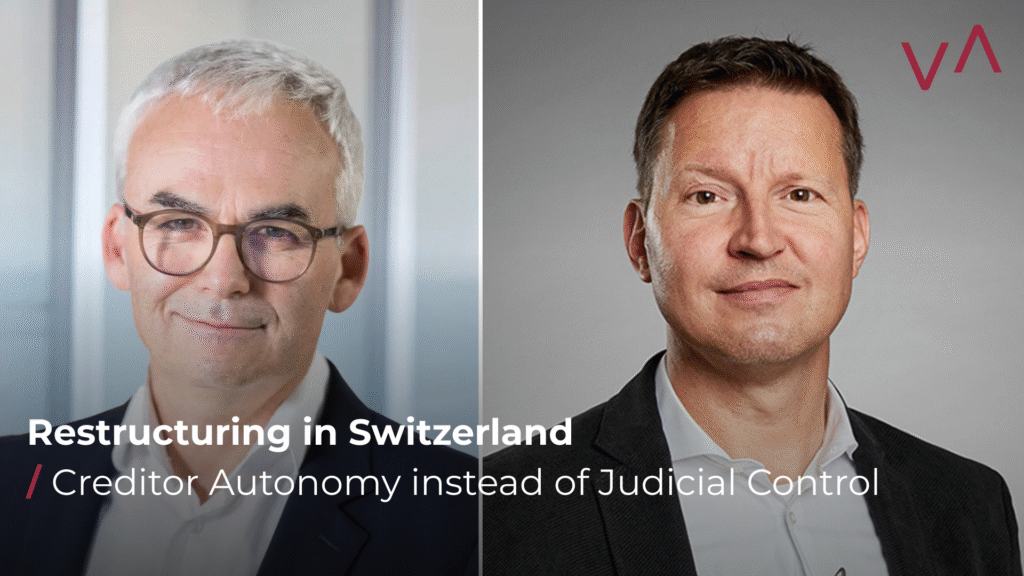
An interview with Roland Kleeb
At Valtus, we draw on an international network of restructuring experts – because every country has its own legal framework and restructuring practices. In this interview, Andreas Greis, partner at Valtus Germany, talks to Roland Kleeb, partner at FS Partners AG in Zurich, about restructuring experience in Switzerland.
What makes the legal framework for insolvency and restructuring in Switzerland unique?
The Swiss legal framework is characterised by its clear focus on restructuring and high degree of practicality. It enables early, flexible solutions and promotes out-of-court restructuring before irreversible damage occurs. The framework governing restructuring and insolvency is clear. In my experience, the combination of legal certainty and pragmatism is a key success factor. At the same time, I consider it extremely important that the responsible bodies comprehensively document or record the situation, their considerations and decisions, and the corresponding basis for their decisions. An important aspect that is often underestimated in reorganisation or restructuring situations is the disclosure of conflicts of interest – and not only in family-run companies. Since 1 January 2025, numerous changes have come into force with the Federal Act on Combating Abusive Bankruptcy. One of the most significant changes is that companies can now also be subject to debt enforcement proceedings for public law claims, such as tax claims.
How does the Swiss legal framework differ from other European countries?
I would summarise the differences to the EU and other EU countries as follows:
Firstly: consensus takes precedence over procedure
Restructuring in Switzerland is primarily conducted out of court. From a legal perspective, this is not a gap, but rather the result of a deliberately streamlined set of instruments. There is no preventive restructuring framework with majority requirements, as provided for in the EU Restructuring Directive or in the German StaRUG. In the absence of statutory cram-down mechanisms, the restructuring of the private autonomy of the parties involved is left to their discretion. The Swiss consensus is therefore less a cultural ornament than a legal necessity.
Secondly: creditor autonomy instead of judicial control
Swiss restructuring law is governed by the SchKG (Federal Act on Debt Enforcement and Bankruptcy) and, although it provides for a formal procedure in the form of a moratorium, the court’s powers of intervention are deliberately limited. The courts are responsible for supervising and confirming the relevant processes, but the structuring of creditor classes and mediation in conflicts of interest do not fall within their remit. In contrast to France or Italy, there is therefore no court-centred restructuring process. The result is a high degree of creditor autonomy, but also a strong dependence on the negotiating skills of the parties involved. Debt moratorium is the Swiss method of choice in cases where an out-of-court solution is no longer possible.
Thirdly: banks as the linchpin of restructuring
Due to the lack of majority voting and the absence of a state restructuring architecture, financing banks and lenders play a central, almost institutional role. Legally speaking, they are merely creditors, but in practice they become coordinators of the restructuring. In practice, statutory moratoriums are often replaced by subordination agreements, bridge financing and standstill agreements. In other European countries, however, this role is more fragmented due to formal procedures or distressed investors.
Fourth: less stigma, more discretion
In Switzerland, formal restructuring procedures are associated with less reputational damage, but are nevertheless rarely initiated at an early stage. The debt moratorium is generally used as a tool to secure solutions that have already been negotiated, rather than as a public early warning tool. This differs significantly from legal systems in which preventive procedures are deliberately used as a visible restructuring framework.
That sounds like less bureaucracy and more autonomy. Is that the case?
To a certain extent, yes – and this brings me to a fifth and final point. Swiss restructuring is characterised by a swift, liquidity focused approach. Statutory moratoriums or judicial enforcement mechanisms play a subordinate role. From a legal perspective, this means that a company’s ability or eligibility for restructuring depends less on legal instruments than on the structure of its creditors. Efficiency is achieved through pragmatism, whereby the enforceability of standards remains limited, but there are signs of a tightening of the rules to prevent abusive bankruptcies. Nevertheless, we recommend seeking legal expertise at an early stage in order to explore all possibilities.
Are mandatory reports or expert opinions required in the event of a liquidity crisis?
As soon as there is a threat of capital loss or over-indebtedness, Swiss law requires the management bodies to take concrete measures. These include, for example, audited interim financial statements and/or a restructuring plan with appropriate restructuring measures. These obligations have a disciplining effect and create transparency – both internally and vis-à-vis owners and creditors.
In your experience, what are the most common mistakes made in the early stages of a crisis?
That depends very much on the crisis and its causes. Nevertheless, we observe that waiting is one of the most common mistakes. Or that an immediate financing solution is sought too quickly instead of first conducting a comprehensive analysis. Many companies react too late because they underestimate external factors, operational problems or market changes, or hope that the situation will stabilise on its own. However, liquidity crises rarely escalate in a linear fashion. The result is usually that a great deal of resources have to be spent on short-term liquidity management, which would be better used elsewhere – for example, for analysis, reporting or project work.
When and in what role should an external restructuring expert be called in – and by whom?
In complex cases, ideally at a very early stage – before a formal crisis materialises. An external expert may be appointed either as a CRO (Chief Restructuring Officer) or as an independent consultant. It is crucial that the mandate comes from the board of directors to ensure clear governance and enforcement. Depending on the trigger of the crisis, specialised technical experts should also be involved at an early stage.
Which case has had the greatest impact on your view of restructuring?
It was the restructuring of a group of companies in an industry that was hit by three very different events at the same time. In other words, the so-called “perfect storm”. There was fierce competition from new and innovative rival products and new user behaviour, combined with enormous margin pressure triggered by the strong Swiss franc and thus significantly cheaper offers from foreign competitors. In addition, major orders were lost. As a result, a large number of decisions had to be taken quickly, while carefully balancing the interests of all stakeholders – employees, creditors, shareholders, customers and suppliers.
Situations like this require a strong management with substantial experience and expertise, combined with consistent leadership and credible communication.
What does the restructuring network of FS Partners AG – A Valtus Company look like?
We work closely with specialised law firms, banks, labour law and tax experts, and valuation specialists. Depending on the industry and business model, other experts are brought in, for example in the area of procurement for international value chains or for special technologies. Restructuring is always a team effort. In cases where there is public interest, communication experts are also typically engaged.
How efficient is the cooperation between management, creditors and courts in Switzerland?
Cooperation in Switzerland is generally very efficient. If preparation is thorough and communication is open, management, creditors and courts tend to act in pragmatic and solution-oriented manner. This combination of pragmatism and willingness to compromise is one of the key strengths of the Swiss system.
What course of action would you recommend for a foreign company with a Swiss subsidiary in serious crisis?
Early local analysis is crucial. Furthermore, liability issues under current legislation, conflicts of interest and ownership of intangible assets and rights should be fully clarified. Securing liquidity and effective liquidity management are crucial in order to allow the necessary time to assess the initial situation and develop measures. This usually prevents further damage. Last but not least, communication with stakeholders must be clearly structured and coordinated at an international level. This is where cultural differences become most apparent. What applies in the country of the parent company may not apply in Switzerland – and vice versa.
What role do relationship banks play in the restructuring process?
In my experience, they are both partners and critical authorities. With clear concepts and transparent communication, they can usually be involved constructively. However, early involvement is also beneficial here. We therefore recommend that every company keep their banks informed about ongoing developments on a regular basis with transparent, recurring reporting, rather than waiting until a crisis arises. This approach builds trust and helps establish a partnership that is invaluable when solutions need to be found under pressure.
Does the Swiss government support companies in crises?
That depends very much on the nature of the crisis. In principle, this does happen from time to time at federal level, but only in a targeted and temporary manner. In most cases, the state tends to support an entire sector or industry. State support instruments are clearly limited in time and subject to strict conditions – they do not replace corporate responsibility. In addition, cantonal governments also have the option of providing relief to companies. However, this is more likely to be the case when there is greater public interest or when a large number of employees are affected.
Thank you very much, Roland, for your insight into the topic of restructuring in Switzerland.
It was my pleasure.