

In many finance teams, contracts are still a blind spot. Contracts come from different departments, end up in shared drives or email inboxes, and are rarely connected to the systems where your actual financial decisions are made.
It’s no surprise, then, that renewal deadlines are overlooked or payment terms never make their way into your planning model. Approval processes run through email chains without clear responsibilities. And as soon as auditors request documents, someone on your team spends two days piecing together information that should have been visible from the start.
This leads to problems that go beyond lost time and avoidable stress. It also has a direct impact on revenue. According to a study by World Commerce and Contracting, companies lose an average of 8.6% of their contract value due to inefficient and poorly managed contracts. These losses arise from error-prone processes, lack of transparency, and missed obligations, causing contract value to erode or never be fully realized.
AI-powered contract management provides a solution. What was a niche technology for legal departments just a few years ago is now a concrete use case for your finance function, with measurable impact on revenue recognition, planning accuracy, compliance, and cost control.
In this article, you will learn how to implement this transformation in practice, when the right time is for your team, and what to pay attention to.
When is AI-powered contract management worthwhile?
First, it’s important to understand the distinction between AI assistance and full contract automation. Both serve different purposes and deliver value at different scales.
| AI Assistance | Full Contract Automation | |
| What it means | AI reads, summarizes, and extracts data from individual contracts | Structured workflows, automated approvals, portfolio-wide deadline tracking, and real-time dashboards for all contracts |
| Who it’s for | Any finance team that reviews, signs, or manages contracts | Finance teams with high contract volume, complex approval processes, or recurring compliance and reporting requirements |
| Minimum volume | None, already useful for individual contracts | From around 30 active contracts |
| Setup effort | Minimal, works from the first imported document | Requires defined processes, templates, and cross-team alignment |
| What you can do with it | Instantly summarize any contract, ask questions in natural language, flag non-standard clauses, automatically extract key data and values, search across all contracts in seconds | All AI assistance features, plus: automatically route approvals, monitor deadlines across the portfolio, feed contract data into your financial reports, maintain a tamper-proof activity log |
The following indicators help you assess whether your team would benefit from full automation:
- You currently manage around 30 or more active contracts at the same time
- Contract data such as payment terms, values, and renewal dates must be looked up manually each time
- Contracts are signed too late, causing revenue to fall into the wrong quarter
- Your team has missed or nearly missed a renewal or termination deadline in the past 12 months
- Preparing for an audit means manually gathering documents from different drives and inboxes
- Your FP&A team plans based on estimates because actual contract terms are not structured or accessible
If two or more of these points apply to you, a targeted shift to full automation already pays off.
Real contract transparency in practice
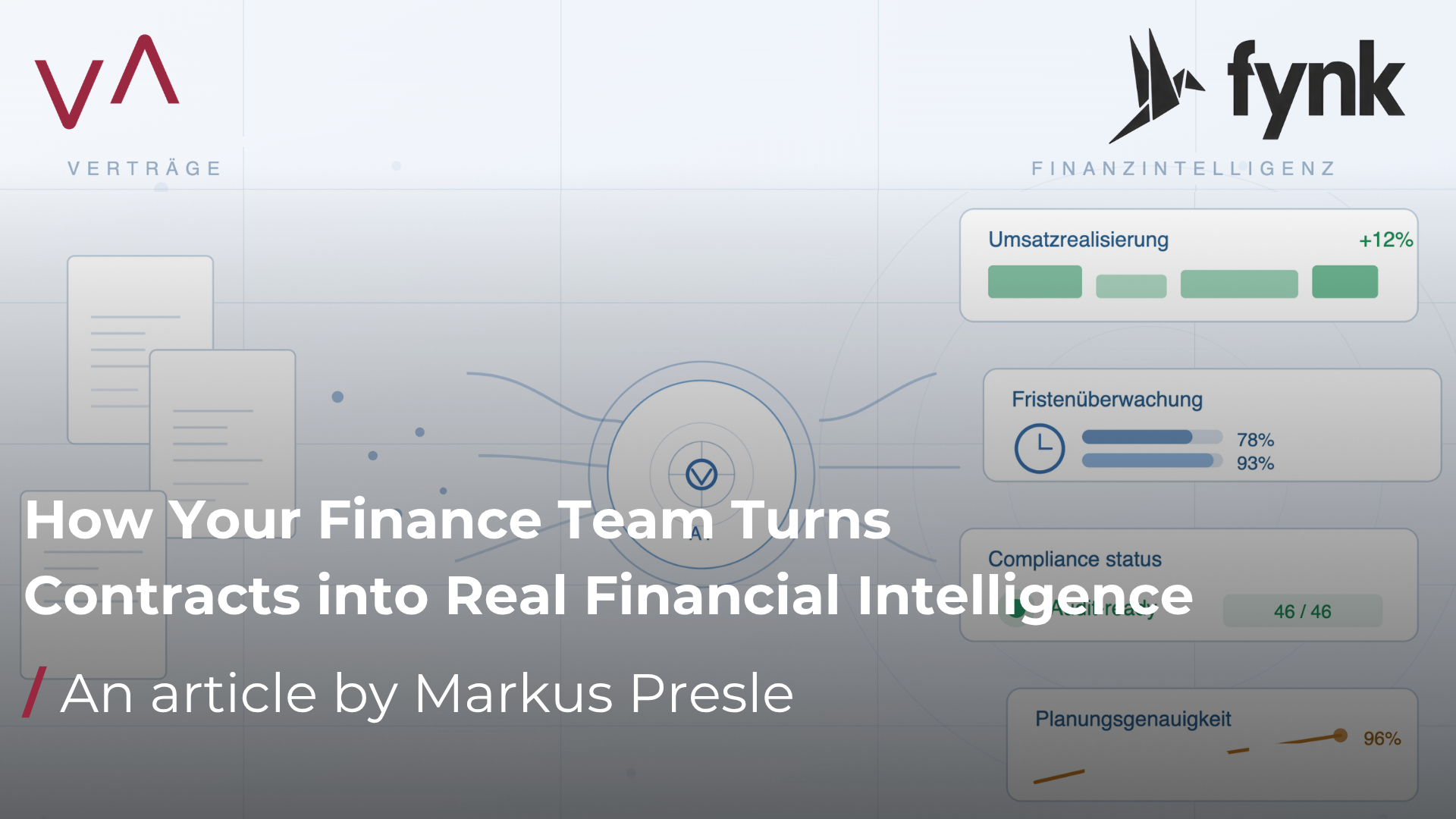
What does this look like in practice? The core idea is simple: instead of letting contracts sit as static files in your financial systems, AI reads each contract upon arrival. The data it contains is automatically structured and then linked to your team’s workflows. As a result, deadlines are tracked automatically, approvals run automatically, and your portfolio becomes visible in real time.
This is exactly what modern contract management platforms are designed for. Using the example of fynk, which covers the entire contract lifecycle from the initial draft to renewal, this can be illustrated concretely.
“Contracts are among the last uncontrolled financial risks in many companies. Finance teams are expected to plan accurately, control costs, and meet compliance requirements, but the data they need is buried in PDFs that no one knows about. Artificial intelligence opens up new possibilities here. It turns contract portfolios from a filing problem into a financial asset.”
— Markus Presle, Co-founder & Chief Revenue Officer at fynk
When you import a contract into fynk, whether a current one or from your legacy portfolio, the AI reads the document and automatically extracts the information relevant to your team: payment terms, contract values, start and end dates, renewal conditions, termination deadlines, and counterparty details. Without manual effort. From the very first moment, the contract becomes structured and queryable data.
What does this mean for your finance team’s day-to-day work?
Your controller no longer needs to manually track renewal deadlines, as automatic reminders reach the right person before a deadline expires. Your FP&A lead plans based on actual contract terms instead of estimates, because dashboards display contract status, upcoming renewals, and financial obligations across the portfolio in real time. And when auditors request documents, they are already prepared, since every access, edit, approval, and signature is automatically logged with a timestamp.
Approval processes also accelerate significantly. Contracts above a defined threshold are automatically forwarded to the responsible stakeholders, with independent reminders if responses are delayed. What used to take weeks now happens in hours.
Before a contract reaches your legal or finance team for approval, fynk also checks it against your internal standards. Clauses that deviate from your approved terms or exceed your defined risk thresholds are flagged. Standard contracts can be forwarded without involving the legal department, while complex documents receive the attention they require.
What should you consider before automating?
You will only achieve the full benefits of AI in your contract management if certain key prerequisites are met.
Define your processes before automating. AI executes exactly the workflow you define. If your approvals are unclear, automation will run faster but still won’t create clarity. First map out your current contract lifecycle from start to finish and identify where financial risks arise.
Align your legal, finance, and procurement teams. All three are involved in contracts at different stages with different priorities. A platform selected by one team without involving the others will create friction later. Early cross-team alignment saves significant rework.
Treat your data migration as a contract audit. Importing your existing contract portfolio is not just an onboarding task. Most finance teams discover obligations, renewal risks, and liability exposures they were unaware of. Plan time for this and use it as an opportunity.
Take data storage seriously. Your contract data is among the most commercially sensitive data in your company. Pay close attention to platforms that operate on EU-certified infrastructure, are fully GDPR-compliant, and provide clear documentation on who can access your data and how it is protected.
5 steps to automated contract management
Step 1: Centralize your contract repository. Bring all your contracts into one system before configuring automation. Platforms like fynk offer AI-powered bulk import, so your legacy documents are structured from day one.
Step 2: Standardize your most common contract types. Create templates for supplier contracts, services, NDAs, and recurring service agreements. These deliver the fastest results for your team.
Step 3: Enable deadline tracking and approval workflows. These two workflows deliver immediate and noticeable time savings and give you the confidence to expand further processes.
Step 4: Start with one contract type and build from there. Measure time saved, renewals identified, and approval cycle duration.
Step 5: Scale based on results. Use data from the first weeks to decide which contract types and workflows to integrate next.
Contracts will always play a central role in finance teams. The question is whether they remain unstructured files sitting in drives or become what they truly are: one of the most valuable data sources in your company. The technology is here. Now it’s up to your team to use it.
FAQs
How long does it take to implement an AI-powered contract management platform?
Getting started with AI assistance works immediately from the first imported contract. Full automation with defined workflows, templates, and cross-team alignment typically takes a few weeks, depending on the size of your contract portfolio and the complexity of your approval processes.
Does AI-powered contract management replace our legal department?
No. AI handles structured data extraction, deadline monitoring, and preliminary contract review. Complex or high-risk documents are still reviewed by your legal department. The difference: your legal team focuses on contracts that truly require legal attention instead of manually reviewing standard documents.
What happens to our existing contracts?
Existing contracts can be transferred into the platform via bulk import. The AI reads each document and automatically extracts the relevant data. Many finance teams use this step as a contract audit and discover previously unknown obligations or renewal risks.
How secure is our contract data in a cloud platform?
When selecting a platform, look for those operating on EU-certified infrastructure and fully compliant with GDPR. What matters is clear documentation on who can access your data, how it is encrypted, and which certifications are in place.
At what contract volume is the investment worthwhile?
AI assistance is worthwhile from the very first contract, for example for automatic summaries or extracting payment terms. Full automation with deadline tracking, approval workflows, and real-time dashboards typically pays off from around 30 active contracts.